
ELI: New Order Notifications vs VendorHub
Two Shopify apps, side by side: detected stores, momentum, reviews, plans, listed features and who runs each. Store counts as of Jul 30, 2026 for ELI, Oct 13, 2026 for VendorHub.
The short answer
- ELI lists 4 features VendorHub’s listing doesn’t mention, including Custom alerts, Multi-channel, Notification rules.
Head to head

Free
- · Auto-fulfillment of vendors items
- · Automatic email alerts (max 2 vendors)
- · Includes 10 orders & 120 scans for free
- · Instant external product creation
- · One-click vendor responses
- · Quality-of-life settings
Growth
- · Automatic WhatsApp alerts
- · Everything from Free plan!
- · Includes 100 orders for free
- · Smart reminder system (up to 1 reminder)
- · Up to 20 vendors
Pro
- · Everything from previous plans!
- · Includes 300 orders for free
- · Smart reminder system (up to 3 reminder)
- · Up to 50 vendors
Ultimate!
- · Everything from previous plans!
- · Full support
- · Unlimited vendors
Coverage counts what each App Store listing names. Every feature, checked off app by app, is in Shoplist.
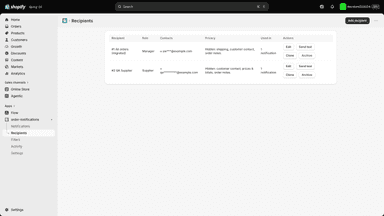
See every featureEvery order has people who need to know, and they are rarely the same people. Order Notifications uses recipient rules: each rule decides who gets notified, which orders trigger it, and how much they can see. Start from a role preset, filter by vendor, product, total or country, and deliver by Slack or webhook.
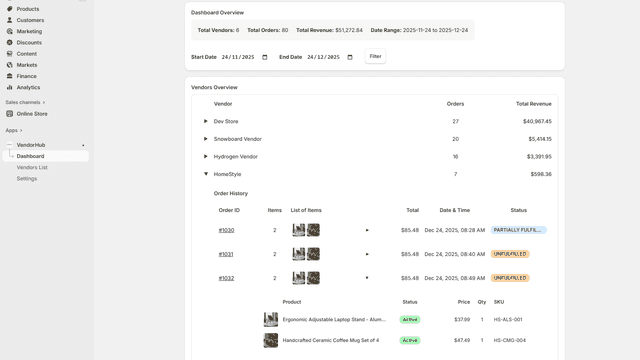
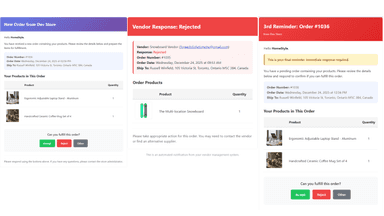
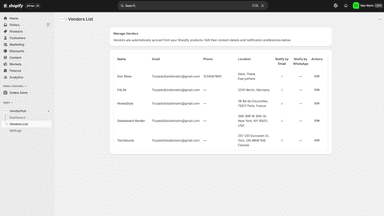
VendorHub automates how you communicate with vendors when orders come in. Vendors receive instant email or WhatsApp notifications with order details and can accept or reject with one click. The app tracks responses, sends smart reminders, auto-fulfills accepted items, and gives you a clear dashboard by vendor with revenue and order status.
- Recipient rules route each order to the right person via Slack or webhook
- Per-recipient privacy: share items and shipping without customer data
- Filters by vendor, product, country, total; duplicate-safe delivery
- Auto-notify vendors when their items are ordered
- One-click vendor responses via built-in options (Accept/Reject/Other)
- Log vendor replies in Order Notes and notify you on rejects
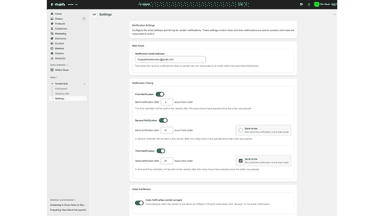
- Send up to 3 follow-up reminders automatically



All the numbers
Every figure, side by side
A green dot marks the app ahead on a measured figure. Estimates, gaps and apps that leave no storefront trace never take the lead.
Adoption
| Measure |  ELI | VendorHub |
|---|---|---|
| Detected stores | Not published | Not published |
| Net store change, 28 days | 0 | 0 |
| Stores added, 28 days | Not enough data | Not enough data |
| Big-brand share | Not enough data | Not enough data |
| Top store categories | Not published | Not published |
| Top store countries | Not published | Not published |
Reviews
| Measure | ELI | VendorHub |
|---|---|---|
| App Store rating | Not published | 5.0 ★ |
| App Store reviews | Not published | 1 |
| New reviews, 28 days | Not enough data | Not enough data |
| Reviewers a year or more in | Not enough data | Not enough data |
FAQ
ELI and VendorHub: common questions
- What features does each app list that the other doesn’t?
- ELI lists 4 the others don’t mention, such as Custom alerts, Multi-channel, Notification rules, Staff notifications. A feature missing from a listing may still be supported; this compares what each App Store listing says.
- Where does this comparison’s data come from?
- Shoplist crawls Shopify storefronts to detect which apps each store runs, and reads each app’s Shopify App Store listing for reviews, pricing, features and integrations. Store counts are as of Jul 30, 2026 for ELI, Oct 13, 2026 for VendorHub; estimated figures are labeled.
How Shoplist compares apps
Store counts come from Shoplist’s crawl of Shopify storefronts, which detects the apps each store runs; they are as of Jul 30, 2026 for ELI, Oct 13, 2026 for VendorHub. Reviews, ratings, plans, features and integrations come from each app’s Shopify App Store listing. 28-day figures are labeled when estimated, and a figure that is missing or estimated never decides who leads. Read the methodology.