
EcomXray vs Foreshelf: Stock Forecasting
Two Shopify apps, side by side: detected stores, momentum, reviews, plans, listed features and who runs each. Store counts as of Oct 13, 2026 for EcomXray, Nov 7, 2026 for Foreshelf.
The short answer
- Both list a free plan. Paid plans start at $29/month for EcomXray and $19/month for Foreshelf.
- Foreshelf lists 2 features EcomXray’s listing doesn’t mention, including Custom reports, Data export.
Head to head


Free
- · 30-day restock recommendations
- · Cost price and gross margin
- · Net units sold: 30 / 90 / 365 days
- · Product analytics inside Shopify
- · Revenue rank for top products
Pro
- · 14-day free trial
- · Chrome extension: stock value + editing
- · Edit product name, description and price
- · Everything in Free
- · Full product activity log
- · Publish to channels, manage collections
Free
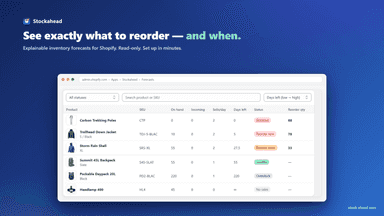
- · Dashboard & status filters
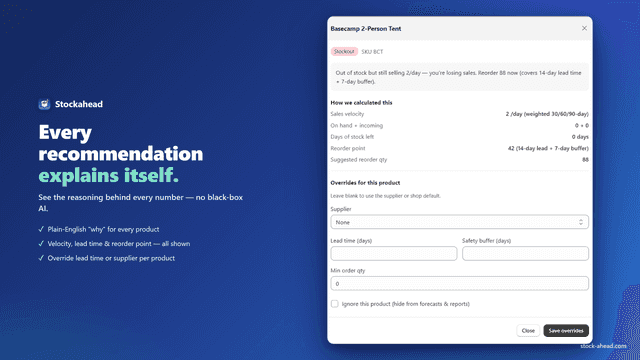
- · Explainable recommendations
- · Import suppliers from Stocky
- · Reorder forecasts for up to 100 SKUs
Starter
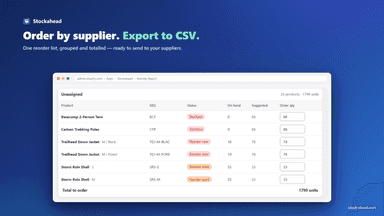
- · CSV export
- · Dead stock, turnover & sell-through
- · Email & Slack reorder alerts
- · Purchase orders, PDF & receiving
- · Reorder report grouped by supplier
- · Seasonality & trend forecasting
Pro
- · Barcode stock receiving & checks
- · Everything in Starter
- · Multi-store inventory sync
- · Priority support
Coverage counts what each App Store listing names. Every feature, checked off app by app, is in Shoplist.
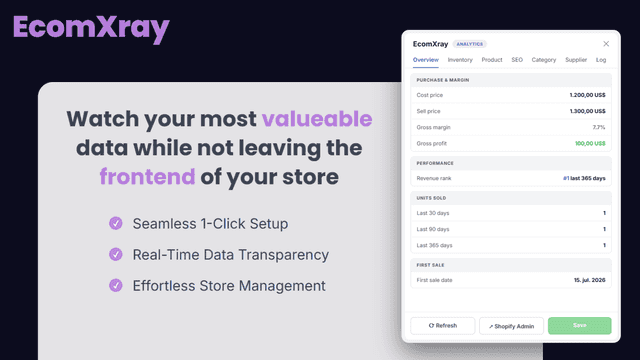
See every featureEcomXray puts the product numbers Shopify doesn't surface in one panel. Pick any product and see its cost price, gross margin, current stock, and net units sold for the last 30/90/365 days — refunds, cancellations and test orders excluded. A restock recommendation based on your real 30-day sales velocity tells you what to reorder and when.
Foreshelf forecasts demand from your sales history and tells you what to reorder, how much, and when — with the reasoning shown: "Sells 5/day, 12 days left, 14-day lead time → reorder 90 now." Forecasts adjust for trend and seasonality. Reorder by supplier, raise purchase orders, receive by barcode, get email or Slack alerts, and track dead stock, turnover and sell-through.
- Net units sold for the last 30, 90 and 365 days — refunds excluded
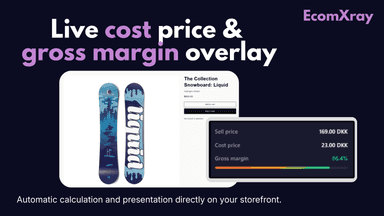
- Gross margin calculated from your real Shopify cost prices
- Restock recommendations from your actual 30-day sales velocity
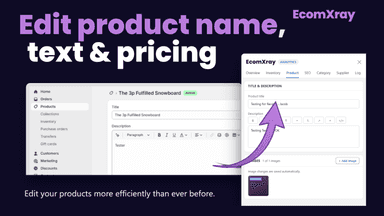
- Edit titles, descriptions and product details without leaving the page
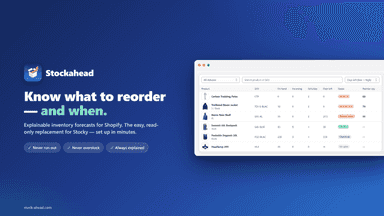
- Never run out — know what to reorder and when, before you lose the sale.
- Never overstock — spot slow movers and dead stock tying up your cash.
- Always explained — every number shows its reasoning in plain English.

All the numbers
Every figure, side by side
A green dot marks the app ahead on a measured figure. Estimates, gaps and apps that leave no storefront trace never take the lead.
Adoption
| Measure |  EcomXray |  Foreshelf |
|---|---|---|
| Detected stores | Not published | Not published |
| Net store change, 28 days | 0 | 0 |
| Stores added, 28 days | Not enough data | Not enough data |
| Big-brand share | Not enough data | Not enough data |
| Top store categories | Not published | Not published |
| Top store countries | Not published | Not published |
Reviews
| Measure | EcomXray | Foreshelf |
|---|---|---|
| App Store rating | Not published | Not published |
| App Store reviews | Not published | Not published |
| New reviews, 28 days | Not enough data | Not enough data |
| Reviewers a year or more in | Not enough data | Not enough data |
FAQ
EcomXray and Foreshelf: common questions
- Is EcomXray or Foreshelf cheaper?
- Both list a free plan. Paid plans start at $29/month for EcomXray and $19/month for Foreshelf. Shoplist compares base prices only between monthly plans in the same currency; usage charges and annual plans vary, so check each plan’s limits.
- What features does each app list that the other doesn’t?
- EcomXray lists 1 the others don’t mention, such as Historical analysis. Foreshelf lists 2 the others don’t mention, such as Custom reports, Data export. A feature missing from a listing may still be supported; this compares what each App Store listing says.
- Where does this comparison’s data come from?
- Shoplist crawls Shopify storefronts to detect which apps each store runs, and reads each app’s Shopify App Store listing for reviews, pricing, features and integrations. Store counts are as of Oct 13, 2026 for EcomXray, Nov 7, 2026 for Foreshelf; estimated figures are labeled.
How Shoplist compares apps
Store counts come from Shoplist’s crawl of Shopify storefronts, which detects the apps each store runs; they are as of Oct 13, 2026 for EcomXray, Nov 7, 2026 for Foreshelf. Reviews, ratings, plans, features and integrations come from each app’s Shopify App Store listing. 28-day figures are labeled when estimated, and a figure that is missing or estimated never decides who leads. Read the methodology.