
Ecom | Order Tax Exempt vs Exemptify
Two Shopify apps, side by side: detected stores, momentum, reviews, plans, listed features and who runs each. Store counts as of Nov 9, 2026.
The short answer
- Exemptify is detected on 124× as many Shopify stores as Ecom: 988 vs 8 as of Nov 9, 2026.
- On the Shopify App Store: Ecom 1.4 from 2 reviews and Exemptify 4.0 from 40 reviews.
- Paid plans start at $3.99/month for Ecom and $4.99/month for Exemptify.
- Exemptify lists 4 features Ecom’s listing doesn’t mention, including Data export, EU (VAT), Tax number validation.
Head to head


Make your shop EU compliant with EU tax laws


- United States
- United Kingdom
- Germany
- Netherlands
- United Kingdom
Momentum
New reviews each month
Review pace is the clearest public read on how fast an app is winning new merchants.
Pro Plan
- · Add widget into cart page
- · Allow customers to attach document
- · Customize text, color, add questions etc
- · Unlimited tax-exempted orders
Standard
Coverage counts what each App Store listing names. Every feature, checked off app by app, is in Shoplist.
See every featureSimply the process of claiming tax-exempt status by adding it to the order placement journey. This minimizes, and may even eliminate, the need for direct communication between the merchant and the customer. As a result, tax-exempt orders are processed more quickly, and the purchasing experience becomes smoother for tax-exempt customers.
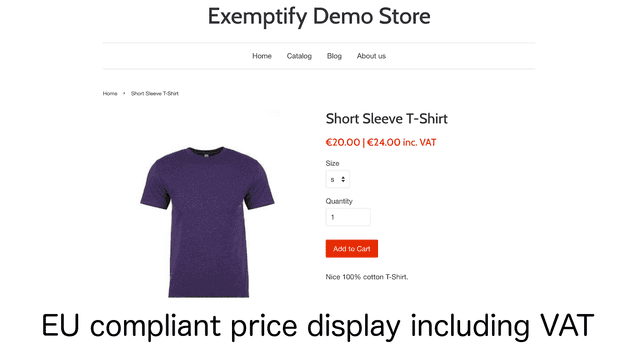
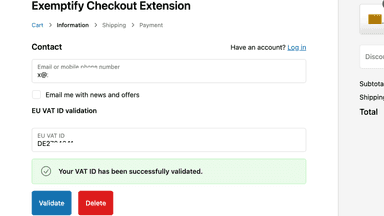
Allow customers to validate their EU VAT ID and get tax-exempted in real-time. Add VAT IDs to existing customers from the Shopify Admin. Shopify Plus stores can integrate the validation module directly in the Checkout. Exemptify also facilitates international sales by displaying correct prices based on customer location, so your customers know right away what they will have to pay at checkout.
- Ensures tax-exempt orders are handled efficiently.
- Adjust the text to align with your preferred wording and language.
- Modify the design of the tax-exempt widget to match your store preferences.
- Allows customers to upload documents to support their tax-exempt status.
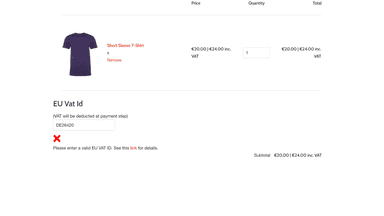
- Validate EU VAT IDs in real-time and automatically deduct VAT
- Show correct prices according to customer's physical location
- Comply with new EU regulations to show prices with customer tax rate




All the numbers
Every figure, side by side
A green dot marks the app ahead on a measured figure. Estimates, gaps and apps that leave no storefront trace never take the lead.
Adoption
| Measure |  Ecom |  Exemptify |
|---|---|---|
| Detected stores | 8 | 988(ahead) |
| Net store change, 28 days | 0 | −32 |
| Stores added, 28 days | Not enough data | 7 |
| Big-brand share | Not enough data | 7% |
| Top store categories | Business & Industrial, Health & Beauty, Arts & Entertainment | Business & Industrial, Home & Garden, Hardware |
| Top store countries | United States, United Kingdom | Germany, Netherlands, United Kingdom |
Reviews
| Measure | Ecom | Exemptify |
|---|---|---|
| App Store rating | 1.4 ★ | 4.0 ★(ahead) |
| App Store reviews | 2 | 40(ahead) |
| New reviews, 28 days | Not enough data | 0 |
| Reviewers a year or more in | Not enough data | Not enough data |
FAQ
Ecom and Exemptify: common questions
- Which is more popular, Ecom or Exemptify?
- Exemptify is detected on 124× as many Shopify stores as Ecom: 988 vs 8 as of Nov 9, 2026.
- Is Ecom or Exemptify cheaper?
- Paid plans start at $3.99/month for Ecom and $4.99/month for Exemptify. Shoplist compares base prices only between monthly plans in the same currency; usage charges and annual plans vary, so check each plan’s limits.
- Which has better reviews, Ecom or Exemptify?
- On the Shopify App Store: Ecom 1.4 from 2 reviews and Exemptify 4.0 from 40 reviews.
- What features does each app list that the other doesn’t?
- Ecom lists 1 the others don’t mention, such as Tax registration. Exemptify lists 4 the others don’t mention, such as Data export, EU (VAT), Tax number validation, Tax rates. A feature missing from a listing may still be supported; this compares what each App Store listing says.
- Where does this comparison’s data come from?
- Shoplist crawls Shopify storefronts to detect which apps each store runs, and reads each app’s Shopify App Store listing for reviews, pricing, features and integrations. Store counts are as of Nov 9, 2026; estimated figures are labeled.
How Shoplist compares apps
Store counts come from Shoplist’s crawl of Shopify storefronts, which detects the apps each store runs; they are as of Nov 9, 2026. Reviews, ratings, plans, features and integrations come from each app’s Shopify App Store listing. 28-day figures are labeled when estimated, and a figure that is missing or estimated never decides who leads. Read the methodology.