

DutyCalc vs DutyCode – Automatic HS Codes
Two Shopify apps, side by side: detected stores, momentum, reviews, plans, listed features and who runs each. Store counts as of Oct 13, 2026 for DutyCalc, Oct 14, 2026 for DutyCode.
The short answer
- Only DutyCalc lists a free plan.
- DutyCalc lists 1 features DutyCode’s listing doesn’t mention, including Tax rates.
Head to head


Momentum
New reviews each month
Review pace is the clearest public read on how fast an app is winning new merchants.
Free
- · 10 duty lookups per month
Pro
- · 1,000 duty lookups per month
Team
- · 10,000 duty lookups per month
Free
- · 25 free product classifications
- · AI HS codes + EU, UK & US extensions
- · Audit existing HS codes for errors
- · CSV, Shopify & Excel exports
- · Codes written straight into Shopify
- · Failed classifications auto-refunded
Coverage counts what each App Store listing names. Every feature, checked off app by app, is in Shoplist.
See every featureDutyCalc scans your product catalog for missing HS/HTS codes and country-of-origin metadata, then calculates current US tariff exposure for ready SKUs. Review base duty, Section 301, Section 232, reciprocal tariffs, total estimated duty, AD/CVD risk, and margin impact before you reprice, reorder, or send products for broker verification.
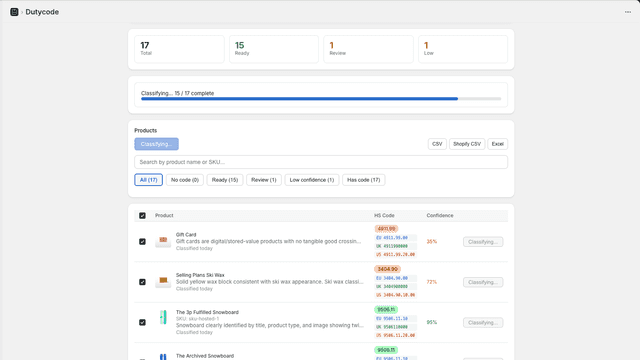
Dutycode automatically assigns HS codes to products in bulk. Extend classifications with EU CN8, UK Commodity Codes, and US HTS Codes. Each assignment includes a confidence score and explanation. Export results to CSV or Excel, or write HS codes directly to product metafields.
- Instant duty rate lookups across 35,000+ HTS tariff codes
- Full duty breakdown at checkout including base, Section 301, 232, and reciprocal
- Simple setup with HS code metafields and a usage tracking dashboard
- AI classification with confidence scores for EU, UK, and US trade codes
- Export to CSV, Shopify Taxes and Duties CSV, or colour-coded Excel
- Writes HS codes directly to Shopify product metafields




All the numbers
Every figure, side by side
A green dot marks the app ahead on a measured figure. Estimates, gaps and apps that leave no storefront trace never take the lead.
Adoption
| Measure |  DutyCalc |  DutyCode |
|---|---|---|
| Detected stores | Not published | Not published |
| Net store change, 28 days | 0 | 0 |
| Stores added, 28 days | Not enough data | Not enough data |
| Big-brand share | Not enough data | Not enough data |
| Top store categories | Not published | Not published |
| Top store countries | Not published | Not published |
Reviews
| Measure | DutyCalc | DutyCode |
|---|---|---|
| App Store rating | Not published | 5.0 ★ |
| App Store reviews | Not published | 3 |
| New reviews, 28 days | Not enough data | Not enough data |
| Reviewers a year or more in | Not enough data | Not enough data |
FAQ
DutyCalc and DutyCode: common questions
- Is DutyCalc or DutyCode cheaper?
- Only DutyCalc lists a free plan. Shoplist compares base prices only between monthly plans in the same currency; usage charges and annual plans vary, so check each plan’s limits.
- What features does each app list that the other doesn’t?
- DutyCalc lists 1 the others don’t mention, such as Tax rates. DutyCode lists 1 the others don’t mention, such as Data export. A feature missing from a listing may still be supported; this compares what each App Store listing says.
- Where does this comparison’s data come from?
- Shoplist crawls Shopify storefronts to detect which apps each store runs, and reads each app’s Shopify App Store listing for reviews, pricing, features and integrations. Store counts are as of Oct 13, 2026 for DutyCalc, Oct 14, 2026 for DutyCode; estimated figures are labeled.
How Shoplist compares apps
Store counts come from Shoplist’s crawl of Shopify storefronts, which detects the apps each store runs; they are as of Oct 13, 2026 for DutyCalc, Oct 14, 2026 for DutyCode. Reviews, ratings, plans, features and integrations come from each app’s Shopify App Store listing. 28-day figures are labeled when estimated, and a figure that is missing or estimated never decides who leads. Read the methodology.