

Duesheet: Customer Statements vs Net Terms Tracker: B2B Credit
Two Shopify apps, side by side: detected stores, momentum, reviews, plans, listed features and who runs each. Store counts as of Oct 23, 2026 for Duesheet, Oct 26, 2026 for Net Terms Tracker.
The short answer
- Both list a free plan. Paid plans start at $24.99/month for Duesheet and $29/month for Net Terms Tracker.
- Net Terms Tracker lists 12 features Duesheet’s listing doesn’t mention, including Branding, Bulk download, Credit notes.
Head to head


Free
- · Aging buckets + running balance
- · Statement PDFs for any customer
Growth
- · Activity statements incl. paid invoices
- · Auto-email statements at month end
- · Everything in Free
- · Saved statement history + re-downloads
Starter
- · Credit limits enforced at checkout
- · Customer Finance Portal with Pay Now
- · Invoice tracking and Mark Paid
- · Overdue notices and account hold
- · Up to 5 Net Terms customers
Pro Plan
- · All of Starter, with unlimited customers
- · Automated payment reminders
- · Branded PDF invoices in 12 languages
- · CSV export and priority support
- · Monthly statements and bank matching
- · Part payments and credit on account
Coverage counts what each App Store listing names. Every feature, checked off app by app, is in Shoplist.
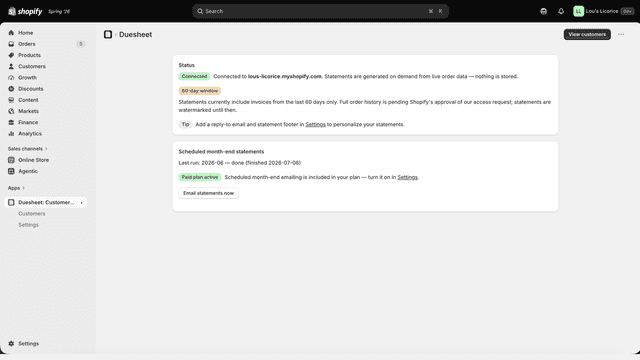
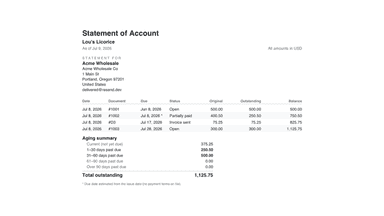
See every featureWholesale and net-terms customers expect a statement of account at month end — the open invoices they owe. Shopify doesn't send one; invoice apps stop at single invoices. Duesheet fills that gap: pick a customer, get a clean statement PDF — open invoices, amounts paid, running balance, and 30/60/90 aging. Statements cover each customer's full order history. No accounting sync, no customer portal.
Shopify's native B2B handles companies and price tiers. It doesn't enforce credit limits, give buyers a self-service invoice portal, or scale past 3 catalogs below Plus. Net Terms Tracker does all three. Approve a customer for Net 15, Net 30, or Net 60 payment terms. Set their credit limit. The app enforces it at checkout, generates a branded PDF invoice, and gives buyers a Finance Portal to pay on their own.
- One-click customer statement for any customer: open invoices + running balance
- 30/60/90-day aging buckets on every statement
- Includes draft-order invoices and net-terms due dates
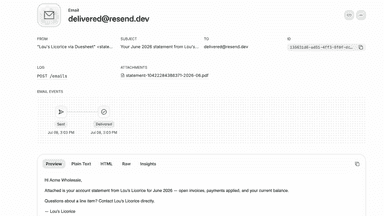
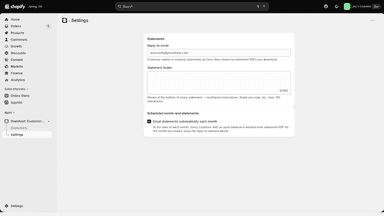
- Automatic month-end statement email to every customer with an open balance
- Assign custom credit limits and block orders if the limit is exceeded.
- Automatically hide Net Terms at checkout for customers with overdue bills.
- Self-service buyer portal to view credit status and download PDF invoices.
- Send automated email reminders to customers for upcoming or overdue bills.


All the numbers
Every figure, side by side
A green dot marks the app ahead on a measured figure. Estimates, gaps and apps that leave no storefront trace never take the lead.
Adoption
| Measure |  Duesheet |  Net Terms Tracker |
|---|---|---|
| Detected stores | Not published | Not published |
| Net store change, 28 days | 0 | 0 |
| Stores added, 28 days | Not enough data | Not enough data |
| Big-brand share | Not enough data | Not enough data |
| Top store categories | Not published | Not published |
| Top store countries | Not published | Not published |
Reviews
| Measure | Duesheet | Net Terms Tracker |
|---|---|---|
| App Store rating | 5.0 ★ | Not published |
| App Store reviews | 1 | Not published |
| New reviews, 28 days | Not enough data | Not enough data |
| Reviewers a year or more in | Not enough data | Not enough data |
Pricing
| Measure | Duesheet | Net Terms Tracker |
|---|---|---|
| Free plan | Yes | Yes |
| Lowest paid monthly plan | $24.99/month(ahead) | $29/month |
| Longest free trial | Not listed | 30 days |
| Plans listed | 2 | 2 |
Listing
| Measure | Duesheet | Net Terms Tracker |
|---|---|---|
| Shopify category rank | #412 | #320(ahead) |
| Shopify App Charts | Not on this week’s charts | Not on this week’s charts |
| Built for Shopify | No | No |
| Launched | Jul 15, 2026 | May 6, 2026 |
| Languages | 1 | 1 |
| Developer | Duesheet | HJBCodeForge |
FAQ
Duesheet and Net Terms Tracker: common questions
- Is Duesheet or Net Terms Tracker cheaper?
- Both list a free plan. Paid plans start at $24.99/month for Duesheet and $29/month for Net Terms Tracker. Shoplist compares base prices only between monthly plans in the same currency; usage charges and annual plans vary, so check each plan’s limits.
- What features does each app list that the other doesn’t?
- Net Terms Tracker lists 12 the others don’t mention, such as Branding, Bulk download, Credit notes, Draft orders. A feature missing from a listing may still be supported; this compares what each App Store listing says.
- Where does this comparison’s data come from?
- Shoplist crawls Shopify storefronts to detect which apps each store runs, and reads each app’s Shopify App Store listing for reviews, pricing, features and integrations. Store counts are as of Oct 23, 2026 for Duesheet, Oct 26, 2026 for Net Terms Tracker; estimated figures are labeled.
How Shoplist compares apps
Store counts come from Shoplist’s crawl of Shopify storefronts, which detects the apps each store runs; they are as of Oct 23, 2026 for Duesheet, Oct 26, 2026 for Net Terms Tracker. Reviews, ratings, plans, features and integrations come from each app’s Shopify App Store listing. 28-day figures are labeled when estimated, and a figure that is missing or estimated never decides who leads. Read the methodology.