

Duesheet: Customer Statements vs Mevale ‑ Net Terms & Aging
Two Shopify apps, side by side: detected stores, momentum, reviews, plans, listed features and who runs each. Store counts as of Oct 23, 2026 for Duesheet, Oct 13, 2026 for Mevale.
The short answer
- Only Duesheet lists a free plan. Paid plans start at $24.99/month for Duesheet and $29/month for Mevale.
- Duesheet lists 1 features Mevale’s listing doesn’t mention, including PDF generation.
Head to head


Free
- · Aging buckets + running balance
- · Statement PDFs for any customer
Growth
- · Activity statements incl. paid invoices
- · Auto-email statements at month end
- · Everything in Free
- · Saved statement history + re-downloads
Starter
- · 4-stage escalation sequences
- · AR aging dashboard
- · Email reminders (your own sender)
- · Up to 25 open invoices
Growth
- · Account-manager CC on escalations
- · Automatic scheduled sweeps
- · Everything in Starter
- · Up to 200 open invoices
Scale
- · Early access to new features
- · Everything in Growth
- · Priority support
- · Unlimited open invoices
Coverage counts what each App Store listing names. Every feature, checked off app by app, is in Shoplist.
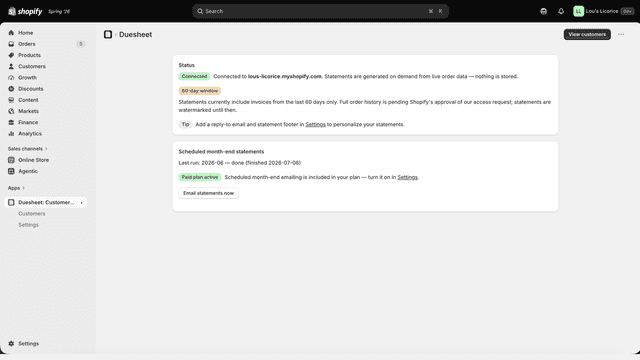
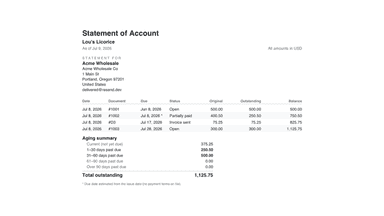
See every featureWholesale and net-terms customers expect a statement of account at month end — the open invoices they owe. Shopify doesn't send one; invoice apps stop at single invoices. Duesheet fills that gap: pick a customer, get a clean statement PDF — open invoices, amounts paid, running balance, and 30/60/90 aging. Statements cover each customer's full order history. No accounting sync, no customer portal.
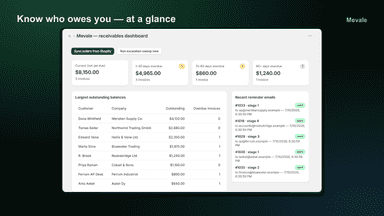
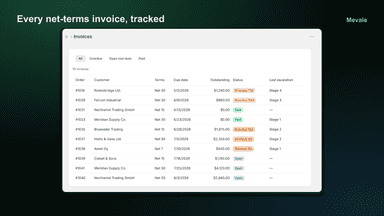
Selling on net terms is easy — getting paid on time isn't. Mevale watches every order you sell on payment terms, shows exactly who owes what in an aging dashboard (current, 1–30, 31–60, 60+ days), and chases late payers with a polite, escalating 4-stage email sequence you fully control. Reminders send from your own email address, so customers pay the business they know. Orders sync automatically via webhooks.
- One-click customer statement for any customer: open invoices + running balance
- 30/60/90-day aging buckets on every statement
- Includes draft-order invoices and net-terms due dates
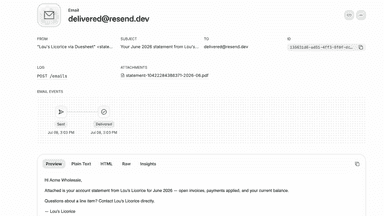
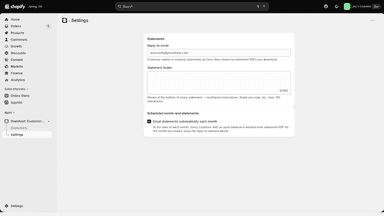
- Automatic month-end statement email to every customer with an open balance
- AR aging dashboard: current, 1–30, 31–60, 60+ day buckets at a glance
- 4-stage escalation emails you fully control — tone, timing, templates
- Reminders sent from YOUR email address — customers pay who they know
- Auto-sync: new orders and payments update invoices instantly


All the numbers
Every figure, side by side
A green dot marks the app ahead on a measured figure. Estimates, gaps and apps that leave no storefront trace never take the lead.
Adoption
| Measure |  Duesheet |  Mevale |
|---|---|---|
| Detected stores | Not published | Not published |
| Net store change, 28 days | 0 | 0 |
| Stores added, 28 days | Not enough data | Not enough data |
| Big-brand share | Not enough data | Not enough data |
| Top store categories | Not published | Not published |
| Top store countries | Not published | Not published |
Reviews
| Measure | Duesheet | Mevale |
|---|---|---|
| App Store rating | 5.0 ★ | Not published |
| App Store reviews | 1 | Not published |
| New reviews, 28 days | Not enough data | Not enough data |
| Reviewers a year or more in | Not enough data | Not enough data |
FAQ
Duesheet and Mevale: common questions
- Is Duesheet or Mevale cheaper?
- Only Duesheet lists a free plan. Paid plans start at $24.99/month for Duesheet and $29/month for Mevale. Shoplist compares base prices only between monthly plans in the same currency; usage charges and annual plans vary, so check each plan’s limits.
- What features does each app list that the other doesn’t?
- Duesheet lists 1 the others don’t mention, such as PDF generation. Mevale lists 1 the others don’t mention, such as Templates. A feature missing from a listing may still be supported; this compares what each App Store listing says.
- Where does this comparison’s data come from?
- Shoplist crawls Shopify storefronts to detect which apps each store runs, and reads each app’s Shopify App Store listing for reviews, pricing, features and integrations. Store counts are as of Oct 23, 2026 for Duesheet, Oct 13, 2026 for Mevale; estimated figures are labeled.
How Shoplist compares apps
Store counts come from Shoplist’s crawl of Shopify storefronts, which detects the apps each store runs; they are as of Oct 23, 2026 for Duesheet, Oct 13, 2026 for Mevale. Reviews, ratings, plans, features and integrations come from each app’s Shopify App Store listing. 28-day figures are labeled when estimated, and a figure that is missing or estimated never decides who leads. Read the methodology.