
Do The Proof vs RebutCase: Chargeback Disputes
Two Shopify apps, side by side: detected stores, momentum, reviews, plans, listed features and who runs each. Store counts as of Oct 13, 2026 for Do The Proof, Nov 18, 2026 for RebutCase.
The short answer
- Both list a free plan.
- RebutCase lists 2 features Do The Proof’s listing doesn’t mention, including Chargeback alerts, Email notifications.
Head to head

Free
- · Drafts only. Sending it is on you.
- · No fee, on any outcome
Growth
- · A dispute you lose costs nothing
- · No subscription; billed through Shopify
- · Paid on wins only
Free
- · 2 response packs a month
- · All evidence checks and case rating
- · Deadline alerts by email
Starter
- · 12 months of results history
- · 15 response packs a month
- · All evidence checks and case rating
Growth
- · 50 response packs a month
- · Full results history
- · Up to 3 alert recipients
Pro
- · Full results history
- · Unlimited response packs
- · Up to 5 alert recipients
Coverage counts what each App Store listing names. Every feature, checked off app by app, is in Shoplist.
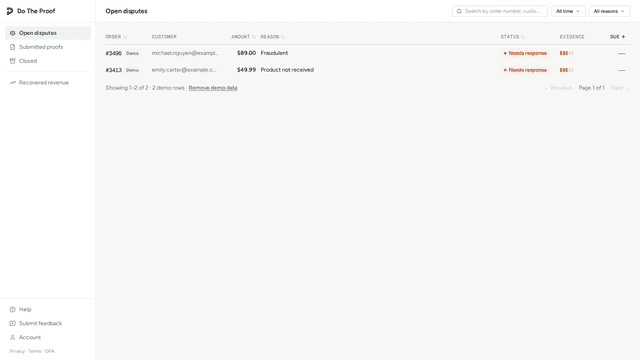
See every featureWhen a customer disputes a payment, Do The Proof picks it up from Shopify, pulls the matching order from your store (customer, fulfillment, tracking, prior orders) and drafts a response to the exact reason the bank gave. You read it, change what you want and approve. On Shopify Payments you paste the approved draft into Shopify's dispute form and Shopify sends it on the due date.
When a chargeback or inquiry arrives, RebutCase collects your store's evidence: the order, payment checks, tracking, customer history and policies. It checks the evidence against the dispute reason, shows what is missing, and drafts a short response where every sentence cites an exhibit, with a timeline and a PDF pack.
- Picks up each new dispute from Shopify, with its reason and status
- Pulls the order, fulfillment, tracking and customer details as evidence
- Drafts the response to the exact reason the bank gave, for you to edit
- Shows which required proofs you have and what would strengthen the case
- Saves product listings and policies as they change, ready for later disputes
- Every sentence in your response cites a piece of your store's evidence
- PDF evidence pack with a timeline of events, the response and each exhibit
- Tracks your chargeback rate next to Shopify's published thresholds


All the numbers
Every figure, side by side
A green dot marks the app ahead on a measured figure. Estimates, gaps and apps that leave no storefront trace never take the lead.
Adoption
| Measure |  Do The Proof | |
|---|---|---|
| Detected stores | Not published | Not published |
| Net store change, 28 days | 0 | 0 |
| Stores added, 28 days | Not enough data | Not enough data |
| Big-brand share | Not enough data | Not enough data |
| Top store categories | Not published | Not published |
| Top store countries | Not published | Not published |
Reviews
| Measure | Do The Proof | |
|---|---|---|
| App Store rating | Not published | Not published |
| App Store reviews | Not published | Not published |
| New reviews, 28 days | Not enough data | Not enough data |
| Reviewers a year or more in | Not enough data | Not enough data |
Pricing
| Measure | Do The Proof | |
|---|---|---|
| Free plan | Yes | Yes |
| Lowest paid monthly plan | No monthly plan listed | $19/month |
| Longest free trial | Not listed | 14 days |
| Plans listed | 2 | 4 |
Listing
| Measure | Do The Proof | |
|---|---|---|
| Shopify category rank | #274 | Not enough data |
| Shopify App Charts | Not on this week’s charts | Not on this week’s charts |
| Built for Shopify | No | No |
| Launched | Oct 8, 2026 | Nov 18, 2026 |
| Languages | 1 | 1 |
| Developer | Do The Proof | Zovio Technologies |
FAQ
Do The Proof and RebutCase: common questions
- Is Do The Proof or RebutCase cheaper?
- Both list a free plan. Shoplist compares base prices only between monthly plans in the same currency; usage charges and annual plans vary, so check each plan’s limits.
- What features does each app list that the other doesn’t?
- RebutCase lists 2 the others don’t mention, such as Chargeback alerts, Email notifications. A feature missing from a listing may still be supported; this compares what each App Store listing says.
- Where does this comparison’s data come from?
- Shoplist crawls Shopify storefronts to detect which apps each store runs, and reads each app’s Shopify App Store listing for reviews, pricing, features and integrations. Store counts are as of Oct 13, 2026 for Do The Proof, Nov 18, 2026 for RebutCase; estimated figures are labeled.
How Shoplist compares apps
Store counts come from Shoplist’s crawl of Shopify storefronts, which detects the apps each store runs; they are as of Oct 13, 2026 for Do The Proof, Nov 18, 2026 for RebutCase. Reviews, ratings, plans, features and integrations come from each app’s Shopify App Store listing. 28-day figures are labeled when estimated, and a figure that is missing or estimated never decides who leads. Read the methodology.