
Markdo: Discount Rules vs Flowly: Discount Functions
Two Shopify apps, side by side: detected stores, momentum, reviews, plans, listed features and who runs each. Store counts as of Nov 3, 2026 for Markdo, Sep 15, 2026 for Flowly.
The short answer
- Markdo lists 16 features Flowly’s listing doesn’t mention, including Analytics, Banners, BOGO.
Head to head


Momentum
New reviews each month
Review pace is the clearest public read on how fast an app is winning new merchants.
Coverage counts what each App Store listing names. Every feature, checked off app by app, is in Shoplist.
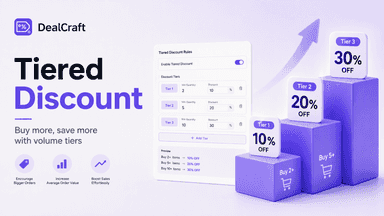
See every featureMarkdo creates automatic discounts for Shopify without editing product prices. Build percentage, fixed, BOGO, buy X get Y, tiered, volume, bulk, free shipping, and gift-with-purchase rules using products, collections, customer tags, cart value, or region. Discounts run at checkout via Shopify Functions.
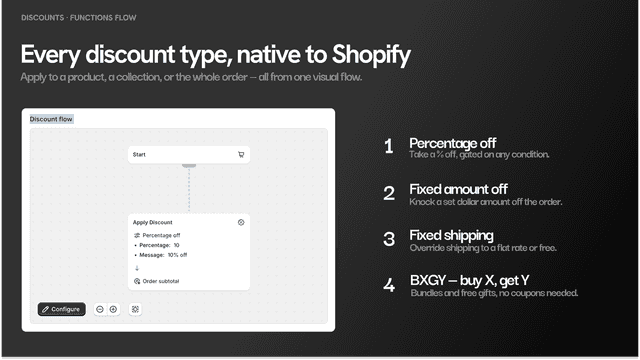
Discounts Functions Flow lets merchants design complex discount logic using a visual drag-and-drop flow builder, powered by native Shopify Functions. Set up conditional rules based on customer, company, market, and order subtotal. Apply percentage or fixed discounts to orders, products, or shipping. Target B2B customers, companies, and locations with segmented rules.
- Visual rule builder for percentage, fixed, BOGO, tiered, and bulk discounts
- Smart conditions targeting products, collections, customer tags, and cart value
- Daily analytics dashboard tracking rule usage, discounts applied, and revenue
- 10+ storefront widgets for countdown timers, sale badges, and tier tables
- Visual flow builder for conditional discount logic
- Apply percentage or fixed discounts to orders, products, or shipping
- Ready-made templates to get started quickly
- Ready-made templates for BOGO, volume discounts & tiered rules





All the numbers
Every figure, side by side
A green dot marks the app ahead on a measured figure. Estimates, gaps and apps that leave no storefront trace never take the lead.
Adoption
| Measure |  Markdo |  Flowly |
|---|---|---|
| Detected stores | Not published | Not published |
| Net store change, 28 days | 0 | 0 |
| Stores added, 28 days | Not enough data | Not enough data |
| Big-brand share | Not enough data | Not enough data |
| Top store categories | Not published | Not published |
| Top store countries | Not published | Not published |
Reviews
| Measure | Markdo | Flowly |
|---|---|---|
| App Store rating | Not published | 5.0 ★ |
| App Store reviews | Not published | 6 |
| New reviews, 28 days | Not enough data | Not enough data |
| Reviewers a year or more in | Not enough data | Not enough data |
FAQ
Markdo and Flowly: common questions
- What features does each app list that the other doesn’t?
- Markdo lists 16 the others don’t mention, such as Analytics, Banners, BOGO, Bulk discounts. Flowly lists 6 the others don’t mention, such as Cart discounts, Custom discounts, Dynamic pricing, Free shipping. A feature missing from a listing may still be supported; this compares what each App Store listing says.
- Where does this comparison’s data come from?
- Shoplist crawls Shopify storefronts to detect which apps each store runs, and reads each app’s Shopify App Store listing for reviews, pricing, features and integrations. Store counts are as of Nov 3, 2026 for Markdo, Sep 15, 2026 for Flowly; estimated figures are labeled.
How Shoplist compares apps
Store counts come from Shoplist’s crawl of Shopify storefronts, which detects the apps each store runs; they are as of Nov 3, 2026 for Markdo, Sep 15, 2026 for Flowly. Reviews, ratings, plans, features and integrations come from each app’s Shopify App Store listing. 28-day figures are labeled when estimated, and a figure that is missing or estimated never decides who leads. Read the methodology.