

DataJet vs Parabola
Two Shopify apps, side by side: detected stores, momentum, reviews, plans, listed features and who runs each. Store counts as of Oct 13, 2026.
The short answer
- On the Shopify App Store: DataJet 5.0 from 16 reviews and Parabola 5.0 from 17 reviews.
- Only DataJet lists a free plan.
- Parabola lists 11 features DataJet’s listing doesn’t mention, including Customer segments, Customer tags, Email responses.
Head to head


Momentum
New reviews each month
Review pace is the clearest public read on how fast an app is winning new merchants.
Trial Plan
- · 10000 credits to use in first 14 days.
Basic Plan
- · Includes 3000 credits to run tasks.
Advanced Plan
- · Includes 14000 credits to run tasks.
Pro Plan
- · Includes 36000 credits to run tasks.
Basic
- · Access to AI steps and visualizations
- · Single user
- · Up to 1,000 credits per month
Coverage counts what each App Store listing names. Every feature, checked off app by app, is in Shoplist.
See every featureDataJet automates the work you would otherwise do by hand or hire a developer for. Describe an automation in plain English and the built-in AI creates it: scheduled tasks, webhook responders, HTTP endpoints, custom shipping rates, inventory syncs, and data exchange with FTP servers, ERPs, and APIs. Customize your checkout with functions for discounts, cart validation, payment and delivery rules, and cart transforms.
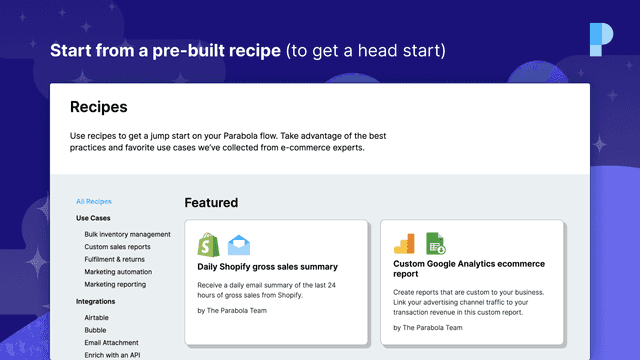
Parabola is the AI agent platform for ops and finance teams. You describe your messy, recurring processes (the work that lives in macros, Python scripts, and tribal knowledge today) like reconciliations, carrier billing audits, accruals, inventory checks, and PO matching.
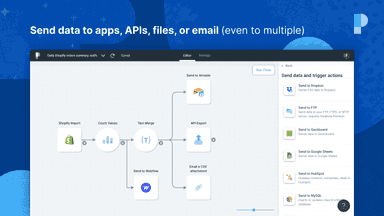
- Sending and receiving data from FTPs
- Integrations with ERPs
- Auto-tagging, automatic fulfillments, custom shipping rates and more
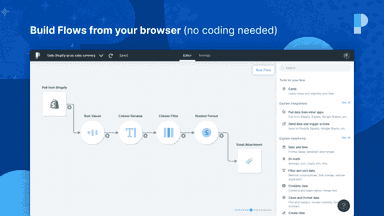
- Automate complex processes to save hours, avoid errors, and align your team
- Schedule Flows that replace your routine data and spreadsheet tasks
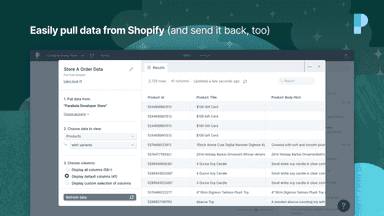
- Pull, Send, and Sync data across tools, spreadsheets, databases, and APIs.
- Manage inventory, customers, 3PL data, custom reports, collections, and tags


All the numbers
Every figure, side by side
A green dot marks the app ahead on a measured figure. Estimates, gaps and apps that leave no storefront trace never take the lead.
Adoption
| Measure |  DataJet |  Parabola |
|---|---|---|
| Detected stores | Not published | Not published |
| Net store change, 28 days | 0 | 0 |
| Stores added, 28 days | Not enough data | Not enough data |
| Big-brand share | Not enough data | Not enough data |
| Top store categories | Not published | Not published |
| Top store countries | Not published | Not published |
Reviews
| Measure | DataJet | Parabola |
|---|---|---|
| App Store rating | 5.0 ★ | 5.0 ★ |
| App Store reviews | 16 | 17(ahead) |
| New reviews, 28 days | 0 | 0 |
| Reviewers a year or more in | Not enough data | Not enough data |
FAQ
DataJet and Parabola: common questions
- Is DataJet or Parabola cheaper?
- Only DataJet lists a free plan. Shoplist compares base prices only between monthly plans in the same currency; usage charges and annual plans vary, so check each plan’s limits.
- Which has better reviews, DataJet or Parabola?
- On the Shopify App Store: DataJet 5.0 from 16 reviews and Parabola 5.0 from 17 reviews.
- What features does each app list that the other doesn’t?
- Parabola lists 11 the others don’t mention, such as Customer segments, Customer tags, Email responses, Fraud detection. A feature missing from a listing may still be supported; this compares what each App Store listing says.
- Where does this comparison’s data come from?
- Shoplist crawls Shopify storefronts to detect which apps each store runs, and reads each app’s Shopify App Store listing for reviews, pricing, features and integrations. Store counts are as of Oct 13, 2026; estimated figures are labeled.
How Shoplist compares apps
Store counts come from Shoplist’s crawl of Shopify storefronts, which detects the apps each store runs; they are as of Oct 13, 2026. Reviews, ratings, plans, features and integrations come from each app’s Shopify App Store listing. 28-day figures are labeled when estimated, and a figure that is missing or estimated never decides who leads. Read the methodology.