
Customs Worksheet vs E‑sellers Integration App
Two Shopify apps, side by side: detected stores, momentum, reviews, plans, listed features and who runs each. Store counts as of Nov 12, 2026 for Customs Worksheet, Oct 30, 2026 for E‑sellers Integration.
The short answer
- E‑sellers Integration lists 9 features Customs Worksheet’s listing doesn’t mention, including Bulk editing, Custom labels, Custom rules.
Head to head

Premium
- · Advanced Filter Rules
- · Email Support
- · Flexible Attribute Mapping
- · Multiple Sync Modes (Stock, Price, etc.)
- · Sync History Tracking
- · Unlimited Products
Premium Plus
- · Advanced Filter Rules
- · Email Support
- · Flexible Attribute Mapping
- · Multiple Sync Modes (Stock, Price, etc.)
- · Sync History Tracking
- · Unlimited Products
Coverage counts what each App Store listing names. Every feature, checked off app by app, is in Shoplist.
See every featureCustoms Worksheet helps Shopify merchants prepare customs documentation for international orders. It uses order and product information from Shopify to create downloadable customs worksheets in PDF format. Merchants can review and complete product details required for customs documentation, including materials, country of origin, tariff codes, and other relevant specifications.
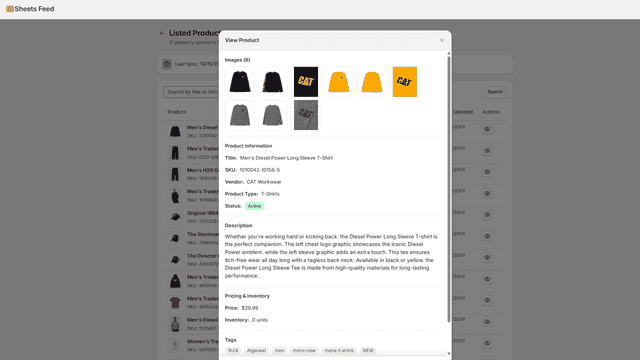
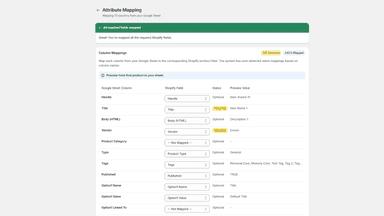
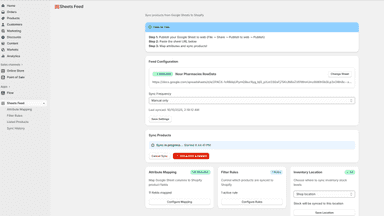
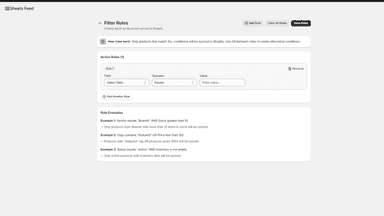
Managing thousands of products across spreadsheets and Shopify is time-consuming and error-prone. Google Sheets Sync solves this by connecting your existing Google Sheets directly to Shopify. Your team updates the spreadsheet, and products sync automatically no manual data entry. Filter which products sync based on stock levels, prices, or custom rules. Map any sheet column format to Shopify fields.
- Generate downloadable customs worksheet PDFs directly from Shopify orders.
- Automatically populate worksheets with Shopify order and product information.
- Add and manage customs details, including HS codes, country of origin, materials
- Bulk sync thousands of products from Google Sheets in minutes, not hours
- Smart filtering syncs only products that meet your custom business rules
- Real-time preview shows exactly which products will sync before you start
- No coding required - connect your Google Sheet URL and start syncing instantly
All the numbers
Every figure, side by side
A green dot marks the app ahead on a measured figure. Estimates, gaps and apps that leave no storefront trace never take the lead.
Adoption
| Measure |  E‑sellers Integration | |
|---|---|---|
| Detected stores | Not published | Not published |
| Net store change, 28 days | 0 | 0 |
| Stores added, 28 days | Not enough data | Not enough data |
| Big-brand share | Not enough data | Not enough data |
| Top store categories | Not published | Not published |
| Top store countries | Not published | Not published |
Reviews
| Measure | E‑sellers Integration | |
|---|---|---|
| App Store rating | Not published | Not published |
| App Store reviews | Not published | Not published |
| New reviews, 28 days | Not enough data | Not enough data |
| Reviewers a year or more in | Not enough data | Not enough data |
Pricing
| Measure | E‑sellers Integration | |
|---|---|---|
| Free plan | Not listed | Not listed |
| Lowest paid monthly plan | No monthly plan listed | $14.99/month |
| Longest free trial | Not listed | Not listed |
| Plans listed | Not published | 2 |
Listing
| Measure | E‑sellers Integration | |
|---|---|---|
| Shopify category rank | Not enough data | #253 |
| Shopify App Charts | Not on this week’s charts | Not on this week’s charts |
| Built for Shopify | No | No |
| Launched | Nov 12, 2026 | Oct 24, 2025 |
| Languages | 1 | 1 |
| Developer | Customs Worksheet | E-Sellers |
FAQ
Customs Worksheet and E‑sellers Integration: common questions
- What features does each app list that the other doesn’t?
- Customs Worksheet lists 7 the others don’t mention, such as AI mapping, Collection targeting, Customs documents, Metafields. E‑sellers Integration lists 9 the others don’t mention, such as Bulk editing, Custom labels, Custom rules, GTIN management. A feature missing from a listing may still be supported; this compares what each App Store listing says.
- Where does this comparison’s data come from?
- Shoplist crawls Shopify storefronts to detect which apps each store runs, and reads each app’s Shopify App Store listing for reviews, pricing, features and integrations. Store counts are as of Nov 12, 2026 for Customs Worksheet, Oct 30, 2026 for E‑sellers Integration; estimated figures are labeled.
How Shoplist compares apps
Store counts come from Shoplist’s crawl of Shopify storefronts, which detects the apps each store runs; they are as of Nov 12, 2026 for Customs Worksheet, Oct 30, 2026 for E‑sellers Integration. Reviews, ratings, plans, features and integrations come from each app’s Shopify App Store listing. 28-day figures are labeled when estimated, and a figure that is missing or estimated never decides who leads. Read the methodology.