

Clevly ‑ AI Business Copilot vs oddly
Two Shopify apps, side by side: detected stores, momentum, reviews, plans, listed features and who runs each. Store counts as of Oct 13, 2026.
The short answer
- Only oddly lists a free plan. Paid plans start at $120/month for Clevly and $19/month for oddly.
- oddly lists 5 features Clevly’s listing doesn’t mention, including Benchmarking, Checkout analytics, Custom reports.
Head to head


Pro
- · AI scan every 6 hours
- · Daily AI alerts & recommendations
- · Full analytics history from day one
- · Real P&L from your accounting data
- · Scale, Review or Stop per product
- · Unified ROAS across all ad platforms
Watch
- · 24/7 monitoring of your connected store
- · 3 priority action previews per week
- · Conversion tracking integrity check
- · Email alerts when something needs you
- · Free forever. No credit card needed.
- · Out-of-stock products flagged daily
Spark
- · Abandoned cart recovery opportunities
- · Daily checks of your whole store
- · Dead stock flagged with cash tied up
- · Guided fixes, never forced discounts
- · Stockout alerts on your best sellers
Coverage counts what each App Store listing names. Every feature, checked off app by app, is in Shoplist.
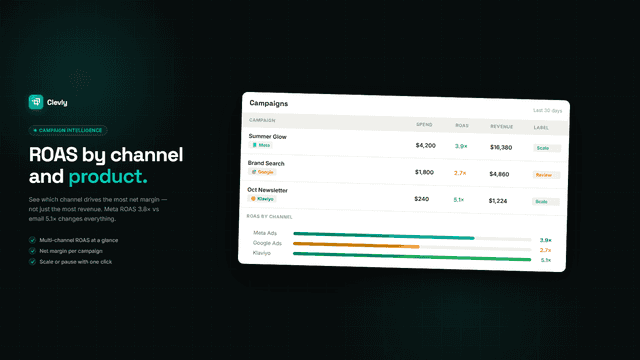
See every featureMost merchants fly blind. Revenue looks fine until it doesn't, and by then you've burned budget on the wrong campaigns, missed a stockout, or lost margin without knowing why. Clevly fixes that. It pulls data from your Shopify store, ad platforms, and accounting tools, then sends you a daily AI briefing with prioritized alerts and recommended actions.
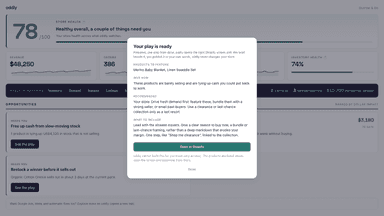
oddly is a budget guardrail for Shopify merchants. It connects to your store in read-only mode, then watches for money leaks: out-of-stock products still being advertised, keywords spending with zero sales, conversion tracking that quietly broke, slow stock tying up cash. Every alert is ranked by real dollars from your own data.
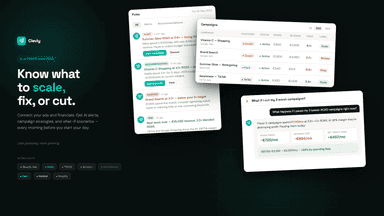
- AI Profit Alerts. Daily AI alerts on underperforming campaigns and margin drops.
- Cross-Platform Ad Analytics. Unified ROAS, spend and revenue.
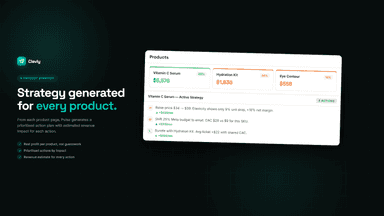
- AI Campaign & Product Strategies. AI action plans per campaign and product.
- What-If Scenarios. Model budget or price changes before you make them.
- Catch wasted ad spend from day one, ranked by real dollars from your own store.
- Every fix is deterministic. Same data, same answer. No AI guessing.
- Every action card shows the problem, the evidence, and the exact fix.
- Read-only by design. oddly never edits your store, your ads, or your prices.



All the numbers
Every figure, side by side
A green dot marks the app ahead on a measured figure. Estimates, gaps and apps that leave no storefront trace never take the lead.
Adoption
| Measure |  Clevly |  oddly |
|---|---|---|
| Detected stores | Not published | Not published |
| Net store change, 28 days | 0 | 0 |
| Stores added, 28 days | Not enough data | Not enough data |
| Big-brand share | Not enough data | Not enough data |
| Top store categories | Not published | Not published |
| Top store countries | Not published | Not published |
Reviews
| Measure | Clevly | oddly |
|---|---|---|
| App Store rating | Not published | Not published |
| App Store reviews | Not published | Not published |
| New reviews, 28 days | Not enough data | Not enough data |
| Reviewers a year or more in | Not enough data | Not enough data |
FAQ
Clevly and oddly: common questions
- Is Clevly or oddly cheaper?
- Only oddly lists a free plan. Paid plans start at $120/month for Clevly and $19/month for oddly. Shoplist compares base prices only between monthly plans in the same currency; usage charges and annual plans vary, so check each plan’s limits.
- What features does each app list that the other doesn’t?
- Clevly lists 3 the others don’t mention, such as Forecasting, Profit insights, ROAS. oddly lists 5 the others don’t mention, such as Benchmarking, Checkout analytics, Custom reports, Funnel analysis. A feature missing from a listing may still be supported; this compares what each App Store listing says.
- Where does this comparison’s data come from?
- Shoplist crawls Shopify storefronts to detect which apps each store runs, and reads each app’s Shopify App Store listing for reviews, pricing, features and integrations. Store counts are as of Oct 13, 2026; estimated figures are labeled.
How Shoplist compares apps
Store counts come from Shoplist’s crawl of Shopify storefronts, which detects the apps each store runs; they are as of Oct 13, 2026. Reviews, ratings, plans, features and integrations come from each app’s Shopify App Store listing. 28-day figures are labeled when estimated, and a figure that is missing or estimated never decides who leads. Read the methodology.