
ClearStock vs Sale House
Two Shopify apps, side by side: detected stores, momentum, reviews, plans, listed features and who runs each. Store counts as of Oct 13, 2026.
The short answer
- Both list a free plan. Paid plans start at $9.99/month for ClearStock and $20/month for Sale House.
- ClearStock lists 14 features Sale House’s listing doesn’t mention, including Auto-matching, Auto-repricing, Bulk editing.
Head to head


Free
- · 2 automatic discount rules
- · 5 product exclusion filters
- · Aging inventory report
- · Automatic discount engine
- · Compare-at price support
- · Track up to 100 products
Starter
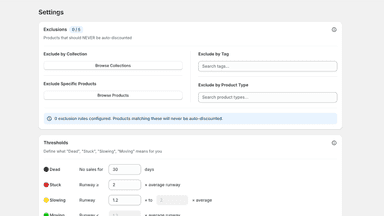
- · 10 product exclusion filters
- · 14-day free trial
- · 5 automatic discount rules
- · Auto Sale & Clearance tagging
- · CSV export reports
- · Compare-at price support
Growth
- · 14-day free trial
- · 15 automatic discount rules
- · 25 product exclusion filters
- · Auto tagging & notifications
- · CSV export reports
- · Compare-at price support
Unlimited
- · 14-day free trial
- · Auto tagging & notifications
- · CSV export reports
- · Compare-at price support
- · Unlimited discount rules
- · Unlimited exclusion filters
Free
- · 20 SKUs per campaign
- · 5 active campaigns
- · 500 synced SKUs
- · All features
Growth
- · 2,000 synced SKUs
- · 20 active campaigns
- · All features
- · Unlimeted SKU per campaign
Coverage counts what each App Store listing names. Every feature, checked off app by app, is in Shoplist.
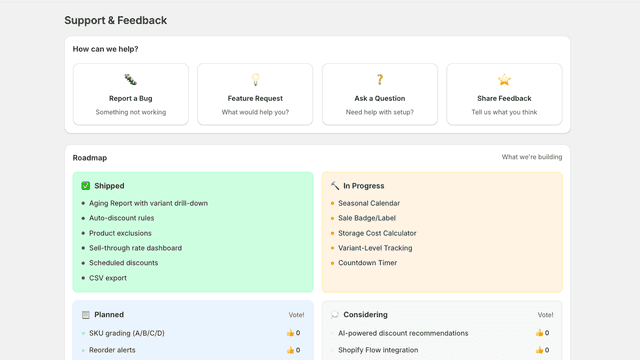
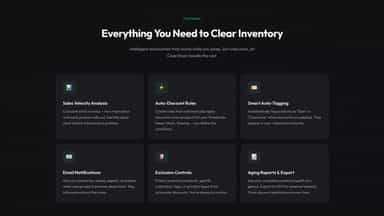
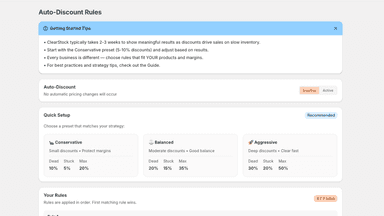
See every featureMost merchants struggle to identify slow-moving inventory before it becomes dead stock. Clear Stock automates this entire process. It tracks sales velocity for every product and calculates how many days of inventory remain based on current sales rates. You set rules like "discount dead products by 30 percent" and the app handles the rest automatically.
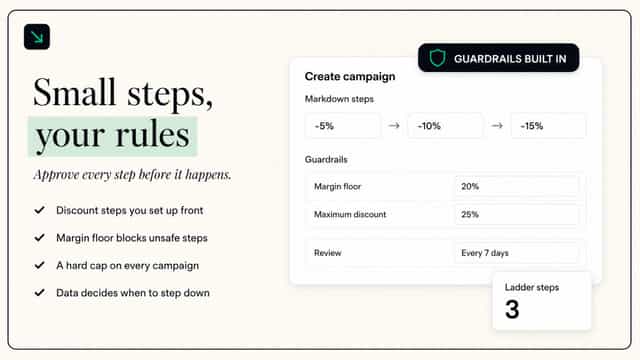
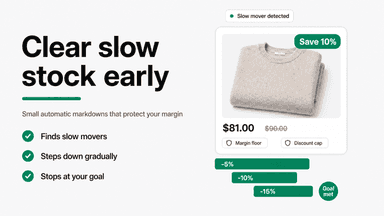
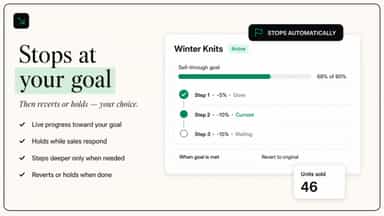
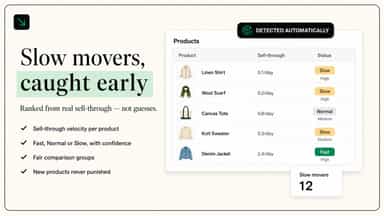
Slow sellers tie up cash until the only fix is deep clearance. Sale House measures how fast each product actually sells, flags slow movers early, and marks them down in small steps you approve up front. Every step is checked against your margin floor and discount cap before any price changes, and the campaign stops once your sales goal is met, then reverts or holds the price.
- Automated discounting prevents products from becoming dead inventory
- Sales velocity tracking identifies which products need attention earliest
- Set rules once and let automation handle all discount applications
- Aging inventory reports show exactly where cash is tied up in stock
- Automatically detects slow-moving products from your real sales history
- Gradual markdown campaigns that discount in small steps you approve up front
- Margin floor, discount cap, and zero-price protection on every price change
- New products are protected until they have enough sales history to judge
All the numbers
Every figure, side by side
A green dot marks the app ahead on a measured figure. Estimates, gaps and apps that leave no storefront trace never take the lead.
Adoption
| Measure |  ClearStock |  Sale House |
|---|---|---|
| Detected stores | Not published | Not published |
| Net store change, 28 days | 0 | 0 |
| Stores added, 28 days | Not enough data | Not enough data |
| Big-brand share | Not enough data | Not enough data |
| Top store categories | Not published | Not published |
| Top store countries | Not published | Not published |
Reviews
| Measure | ClearStock | Sale House |
|---|---|---|
| App Store rating | 5.0 ★ | Not published |
| App Store reviews | 1 | Not published |
| New reviews, 28 days | Not enough data | Not enough data |
| Reviewers a year or more in | Not enough data | Not enough data |
Pricing
| Measure | ClearStock | Sale House |
|---|---|---|
| Free plan | Yes | Yes |
| Lowest paid monthly plan | $9.99/month(ahead) | $20/month |
| Longest free trial | 14 days | 7 days |
| Plans listed | 4 | 2 |
Listing
| Measure | ClearStock | Sale House |
|---|---|---|
| Shopify category rank | #102(ahead) | #329 |
| Shopify App Charts | Not on this week’s charts | Not on this week’s charts |
| Built for Shopify | No | No |
| Launched | Jan 1, 2026 | Jul 13, 2026 |
| Languages | 1 | 1 |
| Developer | Unified Commerce | Gradient |
FAQ
ClearStock and Sale House: common questions
- Is ClearStock or Sale House cheaper?
- Both list a free plan. Paid plans start at $9.99/month for ClearStock and $20/month for Sale House. Shoplist compares base prices only between monthly plans in the same currency; usage charges and annual plans vary, so check each plan’s limits.
- What features does each app list that the other doesn’t?
- ClearStock lists 14 the others don’t mention, such as Auto-matching, Auto-repricing, Bulk editing, Dashboards. Sale House lists 1 the others don’t mention, such as A/B testing. A feature missing from a listing may still be supported; this compares what each App Store listing says.
- Where does this comparison’s data come from?
- Shoplist crawls Shopify storefronts to detect which apps each store runs, and reads each app’s Shopify App Store listing for reviews, pricing, features and integrations. Store counts are as of Oct 13, 2026; estimated figures are labeled.
How Shoplist compares apps
Store counts come from Shoplist’s crawl of Shopify storefronts, which detects the apps each store runs; they are as of Oct 13, 2026. Reviews, ratings, plans, features and integrations come from each app’s Shopify App Store listing. 28-day figures are labeled when estimated, and a figure that is missing or estimated never decides who leads. Read the methodology.