
Catalog QA: Barcode & SKU vs Feedwatch: Google & Meta Audit
Two Shopify apps, side by side: detected stores, momentum, reviews, plans, listed features and who runs each. Store counts as of Nov 16, 2026 for Catalog QA, Oct 14, 2026 for Feedwatch.
The short answer
- Both list a free plan. Paid plans start at $9.99/month for Catalog QA and $19/month for Feedwatch.
- Catalog QA lists 1 features Feedwatch’s listing doesn’t mention, including Feed optimization.
Head to head

Free
Pro
Free
- · Apply your first 5 AI categories
- · Draft 10 AI descriptions, save 5
- · Full scan of your catalog
- · Weekly email while issues remain
- · What each is missing, and a suggestion
Standard
- · AI descriptions, up to 200 a day
- · Bulk-apply AI categories, undo anytime
- · Each product Google disapproved, and why
- · Everything in Free
- · Fix a barcode without leaving the app
Coverage counts what each App Store listing names. Every feature, checked off app by app, is in Shoplist.
See every featureCatalog QA reads your products and lists what needs fixing, grouped by problem: SKUs or barcodes shared by more than one variant, GTIN, UPC, EAN and ISBN codes with a wrong check digit or length, and variants with no barcode, weight or price. It also flags products without a category, images or alt text. Each row links to the product in your admin. The app only reads your catalog and never changes a product.
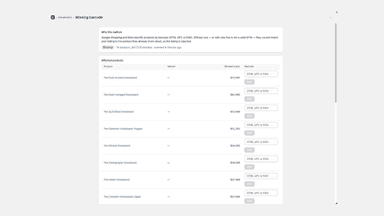
Google and Meta won't list a product with no image or brand. Meta also requires a description, and Google may show a product less when its description, barcode or category is missing. In your admin they still look published. Feedwatch scans your catalog and ranks the affected products by listed price. Fix them here: add a barcode, apply the categories AI suggests, or let it draft a missing description.
- Duplicate SKUs and barcodes, matching UPC and EAN forms of the same code
- Check digit and length checks for GTIN, UPC, EAN and ISBN barcodes
- Missing barcode, weight, product category, images and image alt text
- Scans your catalog and shows which products shopping channels will not list
- Prices every issue in your own stock value, so you fix the costly ones first
- Fix a missing barcode or product category without leaving the app
- Set one category across hundreds of products in a single action


All the numbers
Every figure, side by side
A green dot marks the app ahead on a measured figure. Estimates, gaps and apps that leave no storefront trace never take the lead.
Adoption
| Measure |  Feedwatch | |
|---|---|---|
| Detected stores | Not published | Not published |
| Net store change, 28 days | 0 | 0 |
| Stores added, 28 days | Not enough data | Not enough data |
| Big-brand share | Not enough data | Not enough data |
| Top store categories | Not published | Not published |
| Top store countries | Not published | Not published |
Reviews
| Measure | Feedwatch | |
|---|---|---|
| App Store rating | Not published | Not published |
| App Store reviews | Not published | Not published |
| New reviews, 28 days | Not enough data | Not enough data |
| Reviewers a year or more in | Not enough data | Not enough data |
Pricing
| Measure | Feedwatch | |
|---|---|---|
| Free plan | Yes | Yes |
| Lowest paid monthly plan | $9.99/month(ahead) | $19/month |
| Longest free trial | 7 days | Not listed |
| Plans listed | 2 | 2 |
Listing
| Measure | Feedwatch | |
|---|---|---|
| Shopify category rank | Not enough data | #241 |
| Shopify App Charts | Not on this week’s charts | Not on this week’s charts |
| Built for Shopify | No | No |
| Launched | Nov 5, 2026 | Sep 9, 2026 |
| Languages | 1 | 1 |
| Developer | CorpCorp | Saliga Software |
FAQ
Catalog QA and Feedwatch: common questions
- Is Catalog QA or Feedwatch cheaper?
- Both list a free plan. Paid plans start at $9.99/month for Catalog QA and $19/month for Feedwatch. Shoplist compares base prices only between monthly plans in the same currency; usage charges and annual plans vary, so check each plan’s limits.
- What features does each app list that the other doesn’t?
- Catalog QA lists 1 the others don’t mention, such as Feed optimization. Feedwatch lists 1 the others don’t mention, such as Bulk editing. A feature missing from a listing may still be supported; this compares what each App Store listing says.
- Where does this comparison’s data come from?
- Shoplist crawls Shopify storefronts to detect which apps each store runs, and reads each app’s Shopify App Store listing for reviews, pricing, features and integrations. Store counts are as of Nov 16, 2026 for Catalog QA, Oct 14, 2026 for Feedwatch; estimated figures are labeled.
How Shoplist compares apps
Store counts come from Shoplist’s crawl of Shopify storefronts, which detects the apps each store runs; they are as of Nov 16, 2026 for Catalog QA, Oct 14, 2026 for Feedwatch. Reviews, ratings, plans, features and integrations come from each app’s Shopify App Store listing. 28-day figures are labeled when estimated, and a figure that is missing or estimated never decides who leads. Read the methodology.