

Catalog Command vs Catavue: Catalog Health
Two Shopify apps, side by side: detected stores, momentum, reviews, plans, listed features and who runs each. Store counts as of Oct 14, 2026 for Catalog Command, Oct 13, 2026 for Catavue.
The short answer
- Paid plans start at $9/month for Catalog Command and $9.99/month for Catavue.
- Catalog Command lists 4 features Catavue’s listing doesn’t mention, including Data export, Historical analysis, Multi-store reports.
Head to head


Essential
- · 250 safe field changes each cycle
- · Exact preview, verify, and rollback
- · Up to 1,000 products
Growth
- · 1,000 automatic changes each cycle
- · 2,000 safe field changes each cycle
- · Opt-in Publish Guard policies
Pro
- · 10,000 safe field changes each cycle
- · Read-only catalog Q&A
- · Storefront reachability checks
Scale
- · 30,000 automatic changes each cycle
- · Portfolio controls for up to 20 stores
- · Two years of verified change history
Standard
Coverage counts what each App Store listing names. Every feature, checked off app by app, is in Shoplist.
See every featureCatalog Command runs a read-only catalog audit and shows exact evidence for product and variant gaps. Review affected products, preview supported changes to titles, vendors, product types, and tags, and stop stale proposals before they overwrite newer Shopify data. Approved changes are verified and retain rollback evidence. Optional catalog protection and bounded readiness tools remain under merchant control.
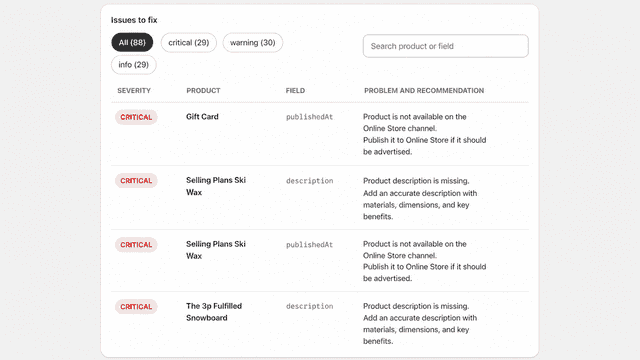
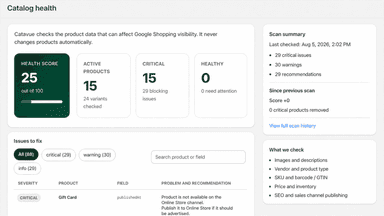
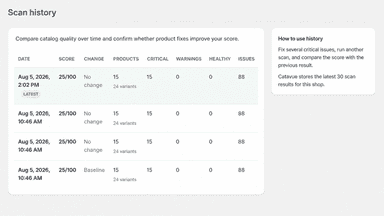
Catavue reviews your product catalog and highlights missing or incomplete data that can affect how products appear across sales channels. It gives your catalog a health score, groups findings by severity, and explains what should be corrected. Merchants stay in control because Catavue does not edit products automatically.
- Find product and variant gaps with exact evidence behind every finding.
- Preview, verify, and roll back supported safe field changes.
- Add opt-in catalog protection and bounded readiness tools when needed.
- Scan product images, descriptions, identifiers, inventory, and SEO fields.
- Prioritize catalog issues by severity with clear, actionable recommendations.
- Track catalog health scores and compare results across previous scans.


All the numbers
Every figure, side by side
A green dot marks the app ahead on a measured figure. Estimates, gaps and apps that leave no storefront trace never take the lead.
Adoption
| Measure |  Catalog Command |  Catavue |
|---|---|---|
| Detected stores | Not published | Not published |
| Net store change, 28 days | 0 | 0 |
| Stores added, 28 days | Not enough data | Not enough data |
| Big-brand share | Not enough data | Not enough data |
| Top store categories | Not published | Not published |
| Top store countries | Not published | Not published |
Reviews
| Measure | Catalog Command | Catavue |
|---|---|---|
| App Store rating | Not published | Not published |
| App Store reviews | Not published | Not published |
| New reviews, 28 days | Not enough data | Not enough data |
| Reviewers a year or more in | Not enough data | Not enough data |
Pricing
| Measure | Catalog Command | Catavue |
|---|---|---|
| Free plan | Not listed | Not listed |
| Lowest paid monthly plan | $9/month(ahead) | $9.99/month |
| Longest free trial | 14 days | 14 days |
| Plans listed | 4 | 1 |
Listing
| Measure | Catalog Command | Catavue |
|---|---|---|
| Shopify category rank | #1588(ahead) | #1602 |
| Shopify App Charts | Not on this week’s charts | Not on this week’s charts |
| Built for Shopify | No | No |
| Launched | Jul 27, 2026 | Aug 12, 2026 |
| Languages | 1 | 1 |
| Developer | DELVIN AS | BMCreator |
FAQ
Catalog Command and Catavue: common questions
- Is Catalog Command or Catavue cheaper?
- Paid plans start at $9/month for Catalog Command and $9.99/month for Catavue. Shoplist compares base prices only between monthly plans in the same currency; usage charges and annual plans vary, so check each plan’s limits.
- What features does each app list that the other doesn’t?
- Catalog Command lists 4 the others don’t mention, such as Data export, Historical analysis, Multi-store reports, Notifications. A feature missing from a listing may still be supported; this compares what each App Store listing says.
- Where does this comparison’s data come from?
- Shoplist crawls Shopify storefronts to detect which apps each store runs, and reads each app’s Shopify App Store listing for reviews, pricing, features and integrations. Store counts are as of Oct 14, 2026 for Catalog Command, Oct 13, 2026 for Catavue; estimated figures are labeled.
How Shoplist compares apps
Store counts come from Shoplist’s crawl of Shopify storefronts, which detects the apps each store runs; they are as of Oct 14, 2026 for Catalog Command, Oct 13, 2026 for Catavue. Reviews, ratings, plans, features and integrations come from each app’s Shopify App Store listing. 28-day figures are labeled when estimated, and a figure that is missing or estimated never decides who leads. Read the methodology.