
CartProof: Sales Pop & Urgency vs eComID
Two Shopify apps, side by side: detected stores, momentum, reviews, plans, listed features and who runs each. Store counts as of Oct 13, 2026 for CartProof, Nov 2, 2026 for eComID.
The short answer
- Only CartProof lists a free plan.
- CartProof lists 6 features eComID’s listing doesn’t mention, including Custom notifications, Live traffic, Product views.
Head to head


- Sweden
- Denmark
- Australia
Free
- · All social-proof and urgency badges
- · Up to 1,000 badge impressions per month
Starter
- · 25,000 impressions per month.
- · For new and small stores.
Growth
- · 150,000 impressions per month
- · For new and small stores
Pro
- · 1,000,000 impressions per month
- · For high-traffic stores
Coverage counts what each App Store listing names. Every feature, checked off app by app, is in Shoplist.
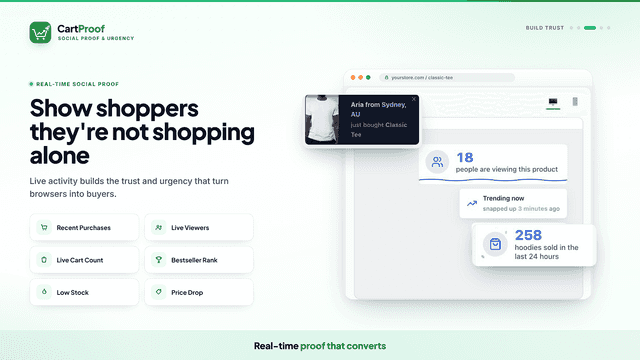
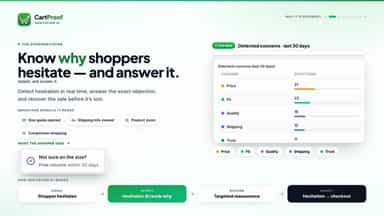
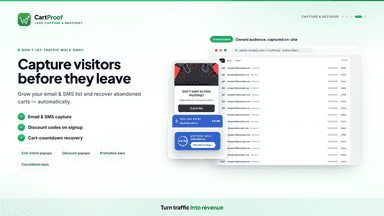
See every featureCartProof increases conversions with social proof and urgency. It shows recent purchases, sold counts, bestseller and trending badges, and a live visitor counter so shoppers see real activity. Urgency tools include low-stock alerts, a cart-countdown timer, promotion bars, and email or SMS opt-in popups. A built-in hesitation assistant notices unsure shoppers and shows relevant reassurance.
Is your brand struggling with product returns? eComID offers integrations to drive mindful shopping behaviors, guiding customers to purchase only what they intend to keep. Using our Green Nudging tool to show the environmental impact of returns and our AI-powered Size Finder to ensure the right fit, eComID reduces bracketing and returns before purchases are made.
- AI hesitation nudges that reassure unsure shoppers about fit, price and more
- Sold count, bestseller and trending badges that highlight popular products
- Live visitor counter and in-cart counts that show real-time demand
- Low-stock alerts, cart-countdown timer and promotion bars to drive urgency
- Reduce bracketing and returns before purchase
- Educate shoppers with Green Nudging
- Increase logged-in customer sessions
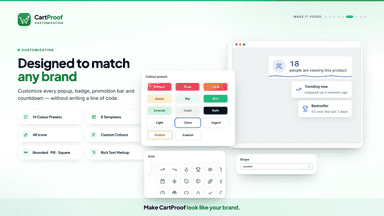
- Customize widgets to match your brand and design
All the numbers
Every figure, side by side
A green dot marks the app ahead on a measured figure. Estimates, gaps and apps that leave no storefront trace never take the lead.
Adoption
| Measure |  CartProof | |
|---|---|---|
| Detected stores | Not published | 16 |
| Net store change, 28 days | 0 | 0 |
| Stores added, 28 days | Not enough data | Not enough data |
| Big-brand share | Not enough data | Not enough data |
| Top store categories | Not published | Apparel & Accessories |
| Top store countries | Not published | Sweden, Denmark, Australia |
Reviews
| Measure | CartProof | |
|---|---|---|
| App Store rating | Not published | Not published |
| App Store reviews | Not published | Not published |
| New reviews, 28 days | Not enough data | Not enough data |
| Reviewers a year or more in | Not enough data | Not enough data |
FAQ
CartProof and eComID: common questions
- Is CartProof or eComID cheaper?
- Only CartProof lists a free plan. Shoplist compares base prices only between monthly plans in the same currency; usage charges and annual plans vary, so check each plan’s limits.
- What features does each app list that the other doesn’t?
- CartProof lists 6 the others don’t mention, such as Custom notifications, Live traffic, Product views, Recent purchases. eComID lists 2 the others don’t mention, such as Custom layouts, Multi-language. A feature missing from a listing may still be supported; this compares what each App Store listing says.
- Where does this comparison’s data come from?
- Shoplist crawls Shopify storefronts to detect which apps each store runs, and reads each app’s Shopify App Store listing for reviews, pricing, features and integrations. Store counts are as of Oct 13, 2026 for CartProof, Nov 2, 2026 for eComID; estimated figures are labeled.
How Shoplist compares apps
Store counts come from Shoplist’s crawl of Shopify storefronts, which detects the apps each store runs; they are as of Oct 13, 2026 for CartProof, Nov 2, 2026 for eComID. Reviews, ratings, plans, features and integrations come from each app’s Shopify App Store listing. 28-day figures are labeled when estimated, and a figure that is missing or estimated never decides who leads. Read the methodology.