

Cartback vs Fasel — Bargaining Popup
Two Shopify apps, side by side: detected stores, momentum, reviews, plans, listed features and who runs each. Store counts as of Oct 14, 2026 for Cartback, Oct 13, 2026 for Fasel.
The short answer
- Both list a free plan. Paid plans start at $9.99/month for Cartback and $15/month for Fasel.
- Fasel lists 8 features Cartback’s listing doesn’t mention, including Custom branding, Custom discount codes, Discount offers.
Head to head


Free
- · Favicon & inactivity nudges
- · Honest message presets
- · Live on-store nudge preview
- · No fake timers
- · Tab-away
Pro
- · 14-day free trial
- · A/B testing & targeting
- · Exit-intent popup & sticky cart bar
- · Honest countdown bound to a real expiry
- · Recovered-revenue dashboard
Free
- · 15 successful bargains per month
- · Pay nothing until deals actually close
- · Single-use expiring discount codes
- · Video merchant with all haggle triggers
Starter
- · 50 successful bargains per month
- · Fasel badge removed from the popup
- · Per-country agents with auto dialect mat
- · Your brand colors and custom script line
Growth
- · 200 successful bargains per month
- · Custom scripts, brand colors, no badge
- · Everything in Tier 2 for growing stores
- · Per-country agents with auto dialect mat
Enterprise
- · Built for high-volume stores
- · Every feature on every trigger
- · Made-for-you custom brand avatar
- · Unlimited successful bargains
Coverage counts what each App Store listing names. Every feature, checked off app by app, is in Shoplist.
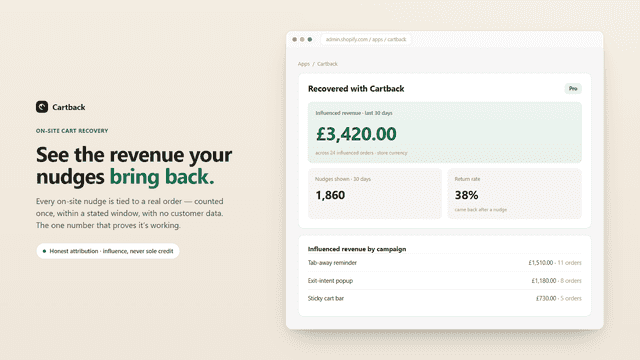
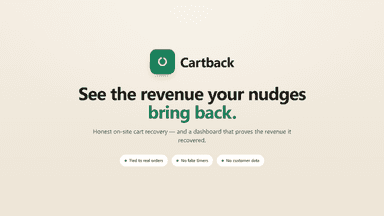
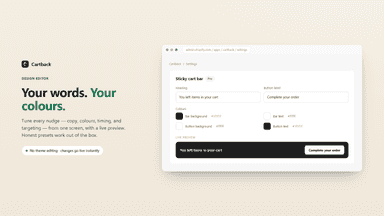
See every featureCartback brings shoppers back to an abandoned cart with on-site nudges: a tab-title reminder, an exit-intent popup, and a sticky cart bar. It ties each nudge to a real order, so you can see how much revenue it influenced - counted once, within a stated 60-minute window, never claimed as sole credit. It also includes a recovered-revenue dashboard, A/B testing, and targeting.
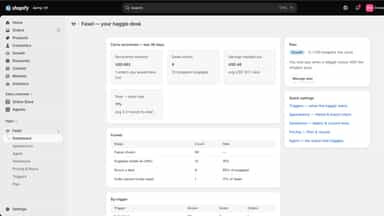
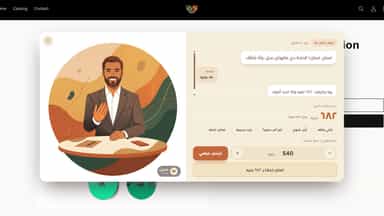
Fasel turns leaving visitors into buyers. A charming video merchant opens a chat-style negotiation: shoppers make offers, the agent counters over 4–6 rounds, and the deal never drops below the floor you set. Winning offers become single-use, expiring Shopify discount codes.
- Recovered-revenue dashboard: every nudge tied to a real order
- On-site nudges: tab reminder, exit-intent popup, sticky cart bar
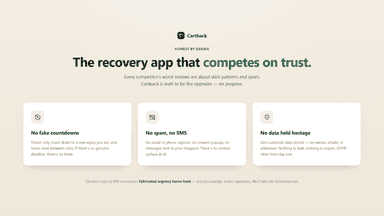
- No fake countdowns, no spam, no customer data stored
- A/B test two popup versions, compared per campaign
- Haggle popup with a live video merchant — 8 Arabic dialects + English
- Your floor is law: server-enforced minimum value, never breached
- Exit-intent, product-page button, and cart-value triggers you control
- Whole-cart haggles issue one percentage code for the entire order


All the numbers
Every figure, side by side
A green dot marks the app ahead on a measured figure. Estimates, gaps and apps that leave no storefront trace never take the lead.
Adoption
| Measure |  Cartback |  Fasel |
|---|---|---|
| Detected stores | Not published | Not published |
| Net store change, 28 days | 0 | 0 |
| Stores added, 28 days | Not enough data | Not enough data |
| Big-brand share | Not enough data | Not enough data |
| Top store categories | Not published | Not published |
| Top store countries | Not published | Not published |
Reviews
| Measure | Cartback | Fasel |
|---|---|---|
| App Store rating | Not published | Not published |
| App Store reviews | Not published | Not published |
| New reviews, 28 days | Not enough data | Not enough data |
| Reviewers a year or more in | Not enough data | Not enough data |
FAQ
Cartback and Fasel: common questions
- Is Cartback or Fasel cheaper?
- Both list a free plan. Paid plans start at $9.99/month for Cartback and $15/month for Fasel. Shoplist compares base prices only between monthly plans in the same currency; usage charges and annual plans vary, so check each plan’s limits.
- What features does each app list that the other doesn’t?
- Cartback lists 2 the others don’t mention, such as A/B testing, Conversion tracking. Fasel lists 8 the others don’t mention, such as Custom branding, Custom discount codes, Discount offers, Games and contests. A feature missing from a listing may still be supported; this compares what each App Store listing says.
- Where does this comparison’s data come from?
- Shoplist crawls Shopify storefronts to detect which apps each store runs, and reads each app’s Shopify App Store listing for reviews, pricing, features and integrations. Store counts are as of Oct 14, 2026 for Cartback, Oct 13, 2026 for Fasel; estimated figures are labeled.
How Shoplist compares apps
Store counts come from Shoplist’s crawl of Shopify storefronts, which detects the apps each store runs; they are as of Oct 14, 2026 for Cartback, Oct 13, 2026 for Fasel. Reviews, ratings, plans, features and integrations come from each app’s Shopify App Store listing. 28-day figures are labeled when estimated, and a figure that is missing or estimated never decides who leads. Read the methodology.