

BuyAhead: Inventory Forecast vs Stockaway ‑ Inventory Planner
Two Shopify apps, side by side: detected stores, momentum, reviews, plans, listed features and who runs each. Store counts as of Oct 13, 2026 for BuyAhead, Oct 20, 2026 for Stockaway.
The short answer
- BuyAhead lists 5 features Stockaway’s listing doesn’t mention, including Analytics, Forecasting, Import and export.
Head to head


Standard
- · CSV export for your supplier
- · Days of stock left, updated daily
- · Dead stock alerts with cash tied up
- · Flat $19/month, no per-order fees
- · Lead time and service level settings
- · Multi-location inventory
Pro
- · Barcode stock counts, phone or scanner
- · Everything in Standard, plus:
- · Flat $49/month, no per-order fees
- · Low-stock and reorder emails
- · Purchase orders with suppliers
- · Receive stock into a location
Coverage counts what each App Store listing names. Every feature, checked off app by app, is in Shoplist.
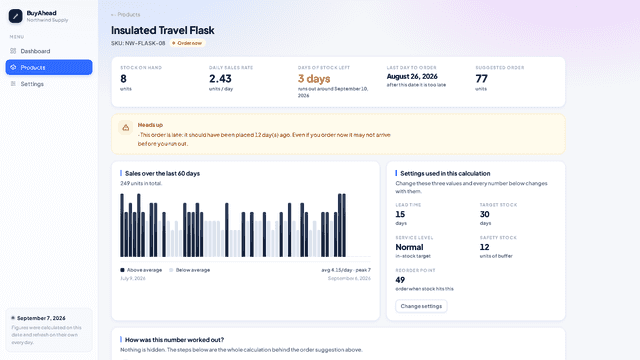
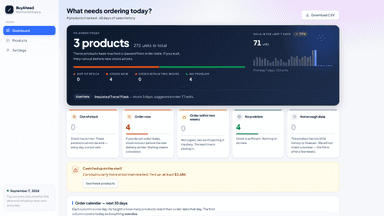
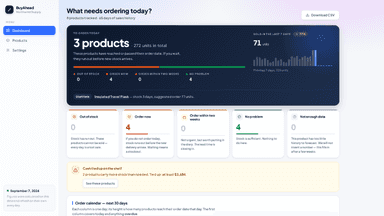
See every featureBuyAhead reads your sales, stock and locations, then works out how long each product will last, when to order it and how much to buy. Open a product to see the math behind every number. When stock arrives, receive it against the purchase order and BuyAhead updates Shopify for you.
Stop guessing what to reorder. Stockaway reads your own order history to work out how fast every variant sells, then gives you a date to order by and a quantity to order — per variant, because sizes and colours never deplete at the same rate. Set a lead time per supplier, draft a purchase order in one click, and receive the stock back into your inventory without retyping it.
- Days of stock left for every product, recalculated every day
- Order dates and quantities, with a breakdown of how each was worked out
- Set your lead time, target stock cover and service level in one screen
- Read-only access: nothing in your store is changed, no customer data is read
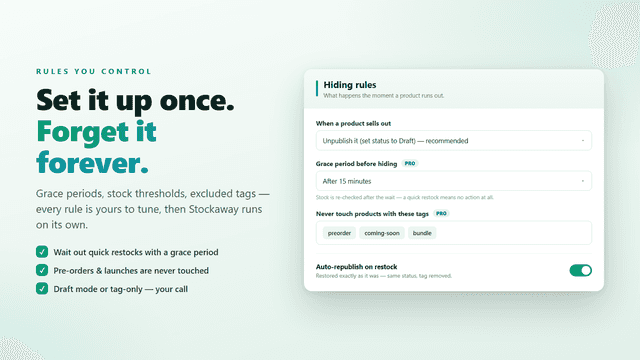
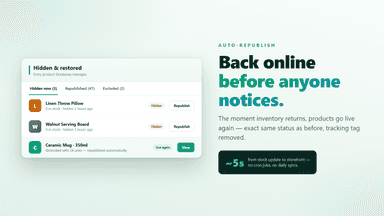
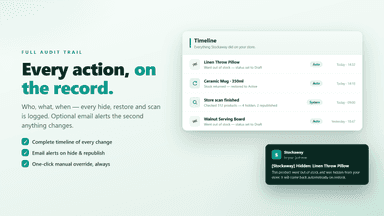
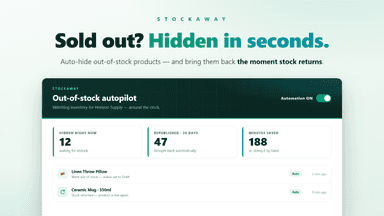
- Real-time: hides products within seconds of the last unit selling out
- Auto-republish restores the exact previous status when stock returns
- Grace period, stock threshold and excluded tags — you set the rules
- Tag-only mode for stores that hide via collections or theme rules

All the numbers
Every figure, side by side
A green dot marks the app ahead on a measured figure. Estimates, gaps and apps that leave no storefront trace never take the lead.
Adoption
| Measure |  BuyAhead |  Stockaway |
|---|---|---|
| Detected stores | Not published | Not published |
| Net store change, 28 days | 0 | 0 |
| Stores added, 28 days | Not enough data | Not enough data |
| Big-brand share | Not enough data | Not enough data |
| Top store categories | Not published | Not published |
| Top store countries | Not published | Not published |
Reviews
| Measure | BuyAhead | Stockaway |
|---|---|---|
| App Store rating | Not published | Not published |
| App Store reviews | Not published | Not published |
| New reviews, 28 days | Not enough data | Not enough data |
| Reviewers a year or more in | Not enough data | Not enough data |
FAQ
BuyAhead and Stockaway: common questions
- What features does each app list that the other doesn’t?
- BuyAhead lists 5 the others don’t mention, such as Analytics, Forecasting, Import and export, Insights. Stockaway lists 4 the others don’t mention, such as Back-in-stock alerts, Email notifications, Inventory tracking, Out of stock notifications. A feature missing from a listing may still be supported; this compares what each App Store listing says.
- Where does this comparison’s data come from?
- Shoplist crawls Shopify storefronts to detect which apps each store runs, and reads each app’s Shopify App Store listing for reviews, pricing, features and integrations. Store counts are as of Oct 13, 2026 for BuyAhead, Oct 20, 2026 for Stockaway; estimated figures are labeled.
How Shoplist compares apps
Store counts come from Shoplist’s crawl of Shopify storefronts, which detects the apps each store runs; they are as of Oct 13, 2026 for BuyAhead, Oct 20, 2026 for Stockaway. Reviews, ratings, plans, features and integrations come from each app’s Shopify App Store listing. 28-day figures are labeled when estimated, and a figure that is missing or estimated never decides who leads. Read the methodology.