

BizCred: B2B Credit Management vs Creditio: B2B Credit Limits
Two Shopify apps, side by side: detected stores, momentum, reviews, plans, listed features and who runs each. Store counts as of Oct 14, 2026 for BizCred, Nov 1, 2026 for Creditio.
The short answer
- Both list a free plan. Paid plans start at $39/month for BizCred and $29/month for Creditio.
Head to head


Free
- · Available only for development stores
- · For merchants testing before launch
Starter
- · 7 Days free trial
- · Minimum order quantity rules
- · Priority email support
Free
- · AR aging dashboard (current to 90+ days)
- · Block checkout: over limit or overdue
- · Credit limits per company
- · Up to 3 companies
- · Warn-only mode and grace period
- · Your own block message
Standard
- · Everything in Free
- · Payment reminder emails in 4 languages
- · Unlimited companies
Pro
- · CSV export of aging and open invoices
- · Everything in Standard
- · Hold orders for review
- · Require upfront payment
- · Temporary company override (1–30 days)
Coverage counts what each App Store listing names. Every feature, checked off app by app, is in Shoplist.
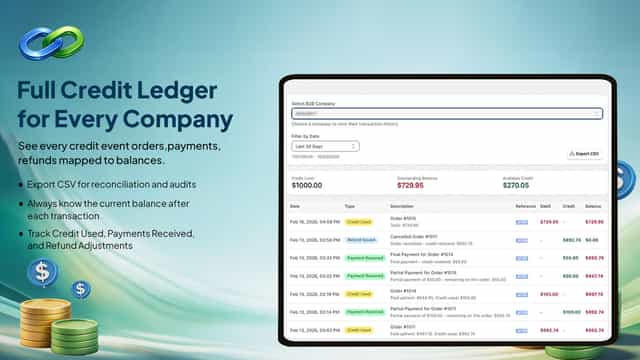
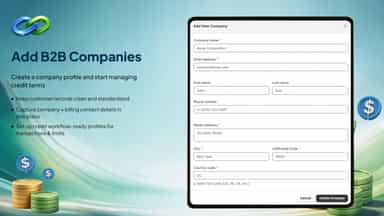
See every featureBizCred helps Shopify merchants run B2B sales with clear credit control. Set customer/company credit limits, assign payment terms, and track balances in a simple ledger. Block or restrict checkout when limits are exceeded, reduce manual follow-ups, and prevent overdue exposure. Keep wholesale purchasing compliant, predictable, and faster for your team and buyers.
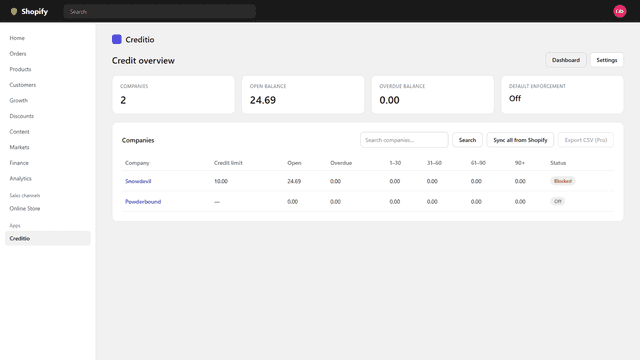
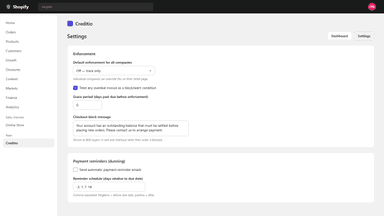
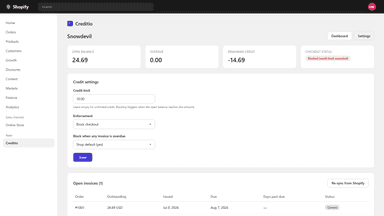
Shopify's native B2B gives wholesale stores companies and net terms, but it doesn't check what a company already owes before it orders again. Creditio adds that check. Set a credit limit per company, block checkout for over-limit or overdue companies with your own message, and see open and overdue balances in 30/60/90+ day buckets.
- Set credit limits and payment terms per company, with automated enforcement
- Real-time B2B ledger: track balance, due amounts, and credit utilization
- Block checkout or restrict payment methods when credit rules are breached
- Block checkout automatically when a company exceeds its credit limit
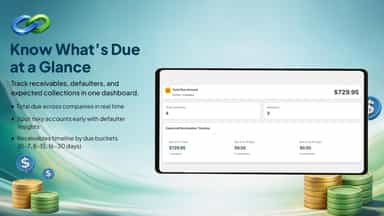
- See AR aging and outstanding balances for every B2B company at a glance
- Automatic multilingual payment reminders sent on your own schedule
- Per-company credit limits with a shop-wide default

All the numbers
Every figure, side by side
A green dot marks the app ahead on a measured figure. Estimates, gaps and apps that leave no storefront trace never take the lead.
Adoption
| Measure |  BizCred |  Creditio |
|---|---|---|
| Detected stores | Not published | Not published |
| Net store change, 28 days | 0 | 0 |
| Stores added, 28 days | Not enough data | Not enough data |
| Big-brand share | Not enough data | Not enough data |
| Top store categories | Not published | Not published |
| Top store countries | Not published | Not published |
Reviews
| Measure | BizCred | Creditio |
|---|---|---|
| App Store rating | Not published | Not published |
| App Store reviews | Not published | Not published |
| New reviews, 28 days | Not enough data | Not enough data |
| Reviewers a year or more in | Not enough data | Not enough data |
FAQ
BizCred and Creditio: common questions
- Is BizCred or Creditio cheaper?
- Both list a free plan. Paid plans start at $39/month for BizCred and $29/month for Creditio. Shoplist compares base prices only between monthly plans in the same currency; usage charges and annual plans vary, so check each plan’s limits.
- Where does this comparison’s data come from?
- Shoplist crawls Shopify storefronts to detect which apps each store runs, and reads each app’s Shopify App Store listing for reviews, pricing, features and integrations. Store counts are as of Oct 14, 2026 for BizCred, Nov 1, 2026 for Creditio; estimated figures are labeled.
How Shoplist compares apps
Store counts come from Shoplist’s crawl of Shopify storefronts, which detects the apps each store runs; they are as of Oct 14, 2026 for BizCred, Nov 1, 2026 for Creditio. Reviews, ratings, plans, features and integrations come from each app’s Shopify App Store listing. 28-day figures are labeled when estimated, and a figure that is missing or estimated never decides who leads. Read the methodology.