
Appify Price Per Unit vs Clarity
Two Shopify apps, side by side: detected stores, momentum, reviews, plans, listed features and who runs each. Store counts as of Nov 9, 2026 for Appify Price Per Unit, Oct 14, 2026 for Clarity.
The short answer
Head to head

Essential
- · Add global pricing callout
Flexible
- · Product & collection targeting
- · Single targeted callout
Multiple
- · Multiple flexible callouts
- · Prioritize callouts
Coverage counts what each App Store listing names. Every feature, checked off app by app, is in Shoplist.
See every featureAppify Price Per Unit adds unit-price labels to product pages. Choose a product, enter its package quantity and unit, and select a reference amount. Preview the price, then add the label in your theme editor. Show prices by weight, volume, length, area, or item. Labels use the selected variant’s price. Variants share one package quantity.
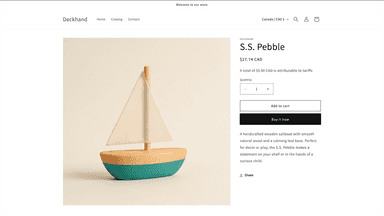
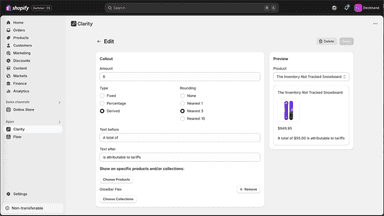
Clarity helps merchants explain how their prices are structured by displaying tariff and cost breakdowns directly on product pages. This makes it easier for customers to understand what they’re paying for, improving trust and reducing confusion at checkout. Merchants can set a single value that applies storewide and add the breakdown using a theme app block—no code or manual product edits required.
- Show a price per weight, volume, length, area, or item
- Choose the package quantity and reference amount for each product
- Preview the calculated unit price before saving
- Add a unit-price label through your theme editor
- Show tariff breakdowns directly on product pages
- Apply a single value across your store with ease
- Add details using a theme block, no code required


All the numbers
Every figure, side by side
A green dot marks the app ahead on a measured figure. Estimates, gaps and apps that leave no storefront trace never take the lead.
Adoption
| Measure |  Clarity | |
|---|---|---|
| Detected stores | Not published | Not published |
| Net store change, 28 days | 0 | 0 |
| Stores added, 28 days | Not enough data | Not enough data |
| Big-brand share | Not enough data | Not enough data |
| Top store categories | Not published | Not published |
| Top store countries | Not published | Not published |
Reviews
| Measure | Clarity | |
|---|---|---|
| App Store rating | Not published | Not published |
| App Store reviews | Not published | Not published |
| New reviews, 28 days | Not enough data | Not enough data |
| Reviewers a year or more in | Not enough data | Not enough data |
Pricing
| Measure | Clarity | |
|---|---|---|
| Free plan | Not listed | Not listed |
| Lowest paid monthly plan | No monthly plan listed | $2/month |
| Longest free trial | Not listed | 3 days |
| Plans listed | Not published | 3 |
Listing
| Measure | Clarity | |
|---|---|---|
| Shopify category rank | Not enough data | Not enough data |
| Shopify App Charts | Not on this week’s charts | Not on this week’s charts |
| Built for Shopify | No | No |
| Launched | Oct 21, 2026 | Jul 7, 2025 |
| Languages | 1 | 1 |
| Developer | Appify Creations | Deckhand |
FAQ
Appify Price Per Unit and Clarity: common questions
- Where does this comparison’s data come from?
- Shoplist crawls Shopify storefronts to detect which apps each store runs, and reads each app’s Shopify App Store listing for reviews, pricing, features and integrations. Store counts are as of Nov 9, 2026 for Appify Price Per Unit, Oct 14, 2026 for Clarity; estimated figures are labeled.
How Shoplist compares apps
Store counts come from Shoplist’s crawl of Shopify storefronts, which detects the apps each store runs; they are as of Nov 9, 2026 for Appify Price Per Unit, Oct 14, 2026 for Clarity. Reviews, ratings, plans, features and integrations come from each app’s Shopify App Store listing. 28-day figures are labeled when estimated, and a figure that is missing or estimated never decides who leads. Read the methodology.