

Antiro vs CODCheck
Two Shopify apps, side by side: detected stores, momentum, reviews, plans, listed features and who runs each. Store counts as of May 14, 2026 for Antiro, Oct 14, 2026 for CODCheck.
The short answer
- Only CODCheck lists a free plan.
- CODCheck lists 7 features Antiro’s listing doesn’t mention, including App notifications, COD validation, Delivery.
Head to head


Free
- · Block & allow lists
- · Risk score on every COD order
- · Shared anti-fraud network
- · Up to 30 orders/month
Start
- · Block & allow lists
- · Hide COD at checkout for risky buyers
- · Risk score on every COD order
- · Up to 400 orders/month
Pro
- · Block & allow lists
- · Risk score on every COD order
- · Shared anti-fraud network
- · Up to 750 orders/month
Unlimited
- · Block & allow lists
- · Risk score on every COD order
- · Shared anti-fraud network
- · Unlimited orders
Coverage counts what each App Store listing names. Every feature, checked off app by app, is in Shoplist.
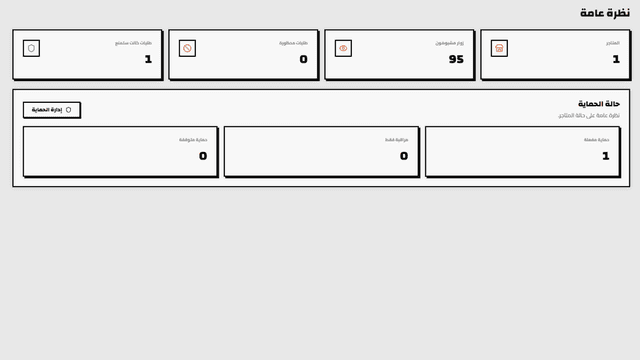
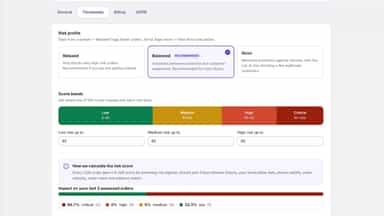
See every featureAntiro is an intelligent fraud prevention system built for e-commerce stores that rely on Cash on Delivery (COD). COD stores face a unique challenge anyone can place a fake order with no payment commitment, costing merchants time, shipping fees, and lost inventory. Antiro solves this by automatically detecting and blocking fraudulent orders using real-time risk scoring and behavioral analysis.
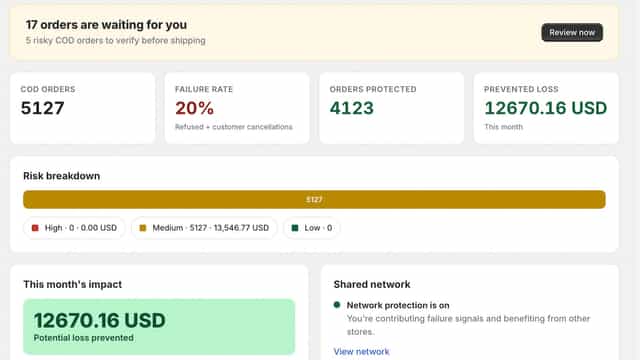
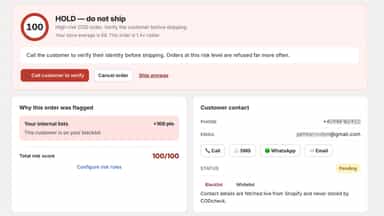
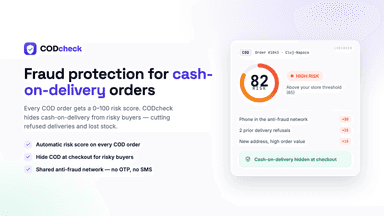
Cash-on-delivery orders are easy to refuse, leaving merchants to cover return shipping on unsold goods. CODcheck reviews each COD order and gives it a risk score from the buyer's phone, email, order history, and refusal signals shared across the CODcheck merchant network.
- Protect your store from fraudulent orders automatically
- See every threat with clear risk scores and analytics
- Save time and reduce costs with automated order reviews
- Automatic fraud risk score for every cash-on-delivery order
- Real-time dashboard with verification analytics
- Shared merchant network that flags buyers who refuse deliveries
- Block and allow lists for phone numbers you control


All the numbers
Every figure, side by side
A green dot marks the app ahead on a measured figure. Estimates, gaps and apps that leave no storefront trace never take the lead.
Adoption
| Measure |  Antiro |  CODCheck |
|---|---|---|
| Detected stores | Not published | Not published |
| Net store change, 28 days | 0 | 0 |
| Stores added, 28 days | Not enough data | Not enough data |
| Big-brand share | Not enough data | Not enough data |
| Top store categories | Not published | Not published |
| Top store countries | Not published | Not published |
Reviews
| Measure | Antiro | CODCheck |
|---|---|---|
| App Store rating | Not published | Not published |
| App Store reviews | Not published | Not published |
| New reviews, 28 days | Not enough data | Not enough data |
| Reviewers a year or more in | Not enough data | Not enough data |
FAQ
Antiro and CODCheck: common questions
- Is Antiro or CODCheck cheaper?
- Only CODCheck lists a free plan. Shoplist compares base prices only between monthly plans in the same currency; usage charges and annual plans vary, so check each plan’s limits.
- What features does each app list that the other doesn’t?
- Antiro lists 2 the others don’t mention, such as Bot detection, Bots. CODCheck lists 7 the others don’t mention, such as App notifications, COD validation, Delivery, Order hold. A feature missing from a listing may still be supported; this compares what each App Store listing says.
- Where does this comparison’s data come from?
- Shoplist crawls Shopify storefronts to detect which apps each store runs, and reads each app’s Shopify App Store listing for reviews, pricing, features and integrations. Store counts are as of May 14, 2026 for Antiro, Oct 14, 2026 for CODCheck; estimated figures are labeled.
How Shoplist compares apps
Store counts come from Shoplist’s crawl of Shopify storefronts, which detects the apps each store runs; they are as of May 14, 2026 for Antiro, Oct 14, 2026 for CODCheck. Reviews, ratings, plans, features and integrations come from each app’s Shopify App Store listing. 28-day figures are labeled when estimated, and a figure that is missing or estimated never decides who leads. Read the methodology.