AltLens: Alt Text & SEO Images vs Catamend: Catalog Health & Fix
Two Shopify apps, side by side: detected stores, momentum, reviews, plans, listed features and who runs each. Store counts as of Oct 13, 2026.
The short answer
- Only AltLens lists a free plan.
- Catamend lists 6 features AltLens’s listing doesn’t mention, including Broken links, Duplicate content, Link analysis.
Head to head


Free — Scan & Fix
Starter — Fix 300
- · Fix up to 300 products
Growth — Fix 1500
- · Fix up to 1500 products
Scale — Fix 5000
- · Fix up to 5000 products
Starter
Growth
Pro
Coverage counts what each App Store listing names. Every feature, checked off app by app, is in Shoplist.
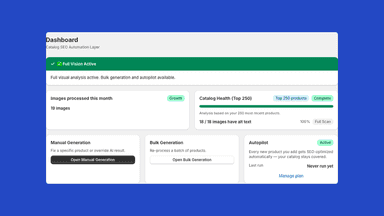
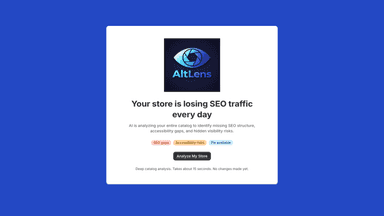
See every featureAltLens scans your entire catalog to find missing alt text, then analyzes both your product images and Shopify product data to generate accurate, descriptive alt text. Start free by scanning your catalog and optimizing your first 5 images. Then fix your entire existing catalog in one automated run with no monthly credit limits. Enable Autopilot to keep every new product optimized automatically.
Catamend continuously audits every product and variant against 19 deterministic health rules — missing images, empty SEO titles and descriptions, duplicate or missing SKUs, duplicate meta descriptions, broken internal links, zero pricing, stale inventory, and more. Findings are ranked by impact so you fix what costs you sales first.
- Fix your entire product catalog SEO in one automated run
- Autopilot keeps every new product SEO-optimized automatically
- AI visual analysis writes accurate alt text using GPT-4 Vision
- Bulk processing handles hundreds of products automatically
- Scans products and variants for images, SEO, SKUs, pricing, links & inventory.
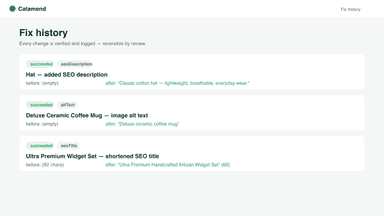
- Preview each change; writes only when a field is empty. Full audit log.
- Alt text, SEO title & description fixed automatically — no manual clicks.




All the numbers
Every figure, side by side
A green dot marks the app ahead on a measured figure. Estimates, gaps and apps that leave no storefront trace never take the lead.
Adoption
| Measure |  AltLens |  Catamend |
|---|---|---|
| Detected stores | Not published | Not published |
| Net store change, 28 days | 0 | 0 |
| Stores added, 28 days | Not enough data | Not enough data |
| Big-brand share | Not enough data | Not enough data |
| Top store categories | Not published | Not published |
| Top store countries | Not published | Not published |
Reviews
| Measure | AltLens | Catamend |
|---|---|---|
| App Store rating | Not published | Not published |
| App Store reviews | Not published | Not published |
| New reviews, 28 days | Not enough data | Not enough data |
| Reviewers a year or more in | Not enough data | Not enough data |
FAQ
AltLens and Catamend: common questions
- Is AltLens or Catamend cheaper?
- Only AltLens lists a free plan. Shoplist compares base prices only between monthly plans in the same currency; usage charges and annual plans vary, so check each plan’s limits.
- What features does each app list that the other doesn’t?
- AltLens lists 3 the others don’t mention, such as AI generation, Analytics, Local SEO. Catamend lists 6 the others don’t mention, such as Broken links, Duplicate content, Link analysis, Meta tags. A feature missing from a listing may still be supported; this compares what each App Store listing says.
- Where does this comparison’s data come from?
- Shoplist crawls Shopify storefronts to detect which apps each store runs, and reads each app’s Shopify App Store listing for reviews, pricing, features and integrations. Store counts are as of Oct 13, 2026; estimated figures are labeled.
How Shoplist compares apps
Store counts come from Shoplist’s crawl of Shopify storefronts, which detects the apps each store runs; they are as of Oct 13, 2026. Reviews, ratings, plans, features and integrations come from each app’s Shopify App Store listing. 28-day figures are labeled when estimated, and a figure that is missing or estimated never decides who leads. Read the methodology.