

AddOnce vs Surcharly
Two Shopify apps, side by side: detected stores, momentum, reviews, plans, listed features and who runs each. Store counts as of Oct 14, 2026.
The short answer
- AddOnce lists 5 features Surcharly’s listing doesn’t mention, including Frequently bought together, One-click add-ons, Product add-ons.
Head to head


AddOnce Unlimited
- · 14-Day Full Access Trial
- · Attach to unlimited products
- · Checkbox & dropdown displays
- · Future updates included
- · Native cart lines
- · Native products & variants
Pro
- · Custom filter design & colors
- · Fast filtering on large catalogs
- · Filters by tag, variant & metafield
- · Multi-language filter support
- · Priority email support
- · Unlimited product filters
Coverage counts what each App Store listing names. Every feature, checked off app by app, is in Shoplist.
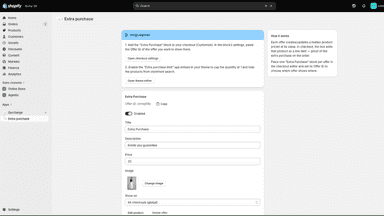
See every featureAddOnce lets merchants present optional products and services directly on the product page. Create a Companion Product once, then attach it to any product where it belongs. Because AddOnce uses native products, inventory, variants, and fulfillment continue to work as expected. Customers choose optional add-ons before adding to cart, and each item is added as its own native cart line.
Surcharly lets you sell extended warranties, protection plans, or any add-on directly at checkout. Each offer appears as a selectable item showing its title, image, and price; buyers add it with one tap, always explicit and never pre-selected. Create multiple offers in the app, show them on all carts or only when specific products are present, and limit each to one per order.
- Add optional add-ons with native Shopify products
- Create once. Attach to unlimited products.
- Customers add each selection as independent Shopify cart lines
- Automatically supports single- and multi-variant companion products
- Sell extended warranties and add-ons as one-tap offers at checkout
- Buyers opt in with explicit consent, never pre-selected or auto-charged
- Show offers on all carts or only when specific products are present
- Add-ons become real line items on the order, ready for fulfillment


All the numbers
Every figure, side by side
A green dot marks the app ahead on a measured figure. Estimates, gaps and apps that leave no storefront trace never take the lead.
Adoption
| Measure |  AddOnce |  Surcharly |
|---|---|---|
| Detected stores | Not published | Not published |
| Net store change, 28 days | 0 | 0 |
| Stores added, 28 days | Not enough data | Not enough data |
| Big-brand share | Not enough data | Not enough data |
| Top store categories | Not published | Not published |
| Top store countries | Not published | Not published |
Reviews
| Measure | AddOnce | Surcharly |
|---|---|---|
| App Store rating | Not published | Not published |
| App Store reviews | Not published | Not published |
| New reviews, 28 days | Not enough data | Not enough data |
| Reviewers a year or more in | Not enough data | Not enough data |
FAQ
AddOnce and Surcharly: common questions
- What features does each app list that the other doesn’t?
- AddOnce lists 5 the others don’t mention, such as Frequently bought together, One-click add-ons, Product add-ons, Product page upsell. Surcharly lists 1 the others don’t mention, such as Checkout upsell. A feature missing from a listing may still be supported; this compares what each App Store listing says.
- Where does this comparison’s data come from?
- Shoplist crawls Shopify storefronts to detect which apps each store runs, and reads each app’s Shopify App Store listing for reviews, pricing, features and integrations. Store counts are as of Oct 14, 2026; estimated figures are labeled.
How Shoplist compares apps
Store counts come from Shoplist’s crawl of Shopify storefronts, which detects the apps each store runs; they are as of Oct 14, 2026. Reviews, ratings, plans, features and integrations come from each app’s Shopify App Store listing. 28-day figures are labeled when estimated, and a figure that is missing or estimated never decides who leads. Read the methodology.