

AB Check: Payment A/B tests vs Rulytic
Two Shopify apps, side by side: detected stores, momentum, reviews, plans, listed features and who runs each. Store counts as of Nov 8, 2026 for AB Check, Oct 13, 2026 for Rulytic.
The short answer
- Only Rulytic lists a free plan. Paid plans start at $19.95/month for AB Check and $49/month for Rulytic.
Head to head


- France
- United Kingdom
- Brazil
Premium Plan
- · Automated traffic allocation
- · Payment gateway performance breakdown
- · Priority email support
- · Real-time conversion analytics
- · Unlimited A/B tests for payment methods
Free
- · 5 payment rules
- · 7-day analytics retention
- · Payment rules only
Pro
- · 90-day analytics retention
- · Delivery rules (Shopify Function)
- · Email support
- · Unlimited payment rules
- · Validation rules (Shopify Function)
Growth
- · 365-day analytics retention
- · A/B testing (Bayesian)
- · Everything in Pro
- · Priority email support
Enterprise
- · API access
- · Custom integrations
- · Everything in Growth
- · Priority phone & email support
- · Unlimited analytics retention
Coverage counts what each App Store listing names. Every feature, checked off app by app, is in Shoplist.
See every featureAB Check helps Shopify merchants evaluate payment method setups using controlled A/B tests in checkout. By comparing variants with real customer traffic, merchants can understand how payment configurations affect conversion rate, AOV, and revenue. Real-time analytics and a built-in kill switch help merchants make informed decisions while reducing risk when changing checkout settings.
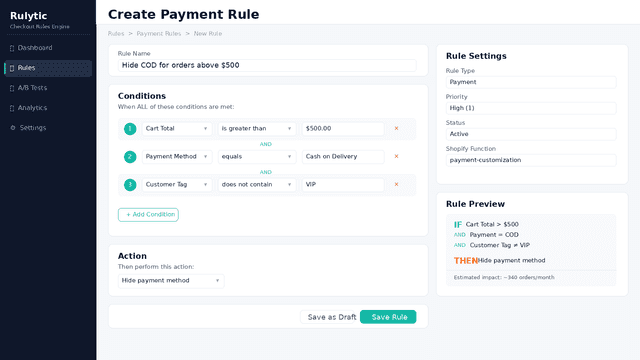
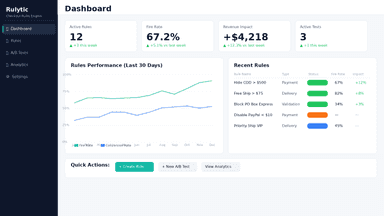
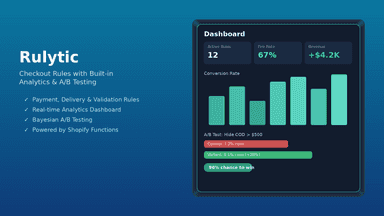
Rulytic is the only Shopify checkout rules app with built-in analytics and A/B testing. Create payment, delivery, and validation rules, then see exactly which ones improve your revenue. Powered by Shopify Functions running as WebAssembly on Shopify's edge infrastructure, your checkout speed is never affected.
- A/B test payment methods directly in Shopify checkout
- Real-time analytics for conversion, AOV, and revenue
- Random traffic splits with consistent cart-based assignment
- Kill switch to instantly disable active checkout experiments
- Payment, delivery, and validation rules with 9+ condition types
- Built-in analytics: impressions, fire rate, conversion, and revenue impact
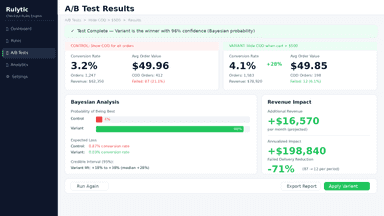
- A/B testing with Bayesian statistics to prove which rules improve revenue




All the numbers
Every figure, side by side
A green dot marks the app ahead on a measured figure. Estimates, gaps and apps that leave no storefront trace never take the lead.
Adoption
| Measure |  AB Check |  Rulytic |
|---|---|---|
| Detected stores | 18 | Not published |
| Net store change, 28 days | +1 | 0 |
| Stores added, 28 days | 1 | Not enough data |
| Big-brand share | Not enough data | Not enough data |
| Top store categories | Health & Beauty, Apparel & Accessories, Home & Garden | Not published |
| Top store countries | France, United Kingdom, Brazil | Not published |
Reviews
| Measure | AB Check | Rulytic |
|---|---|---|
| App Store rating | Not published | Not published |
| App Store reviews | Not published | Not published |
| New reviews, 28 days | Not enough data | Not enough data |
| Reviewers a year or more in | Not enough data | Not enough data |
FAQ
AB Check and Rulytic: common questions
- Is AB Check or Rulytic cheaper?
- Only Rulytic lists a free plan. Paid plans start at $19.95/month for AB Check and $49/month for Rulytic. Shoplist compares base prices only between monthly plans in the same currency; usage charges and annual plans vary, so check each plan’s limits.
- Where does this comparison’s data come from?
- Shoplist crawls Shopify storefronts to detect which apps each store runs, and reads each app’s Shopify App Store listing for reviews, pricing, features and integrations. Store counts are as of Nov 8, 2026 for AB Check, Oct 13, 2026 for Rulytic; estimated figures are labeled.
How Shoplist compares apps
Store counts come from Shoplist’s crawl of Shopify storefronts, which detects the apps each store runs; they are as of Nov 8, 2026 for AB Check, Oct 13, 2026 for Rulytic. Reviews, ratings, plans, features and integrations come from each app’s Shopify App Store listing. 28-day figures are labeled when estimated, and a figure that is missing or estimated never decides who leads. Read the methodology.